Start here
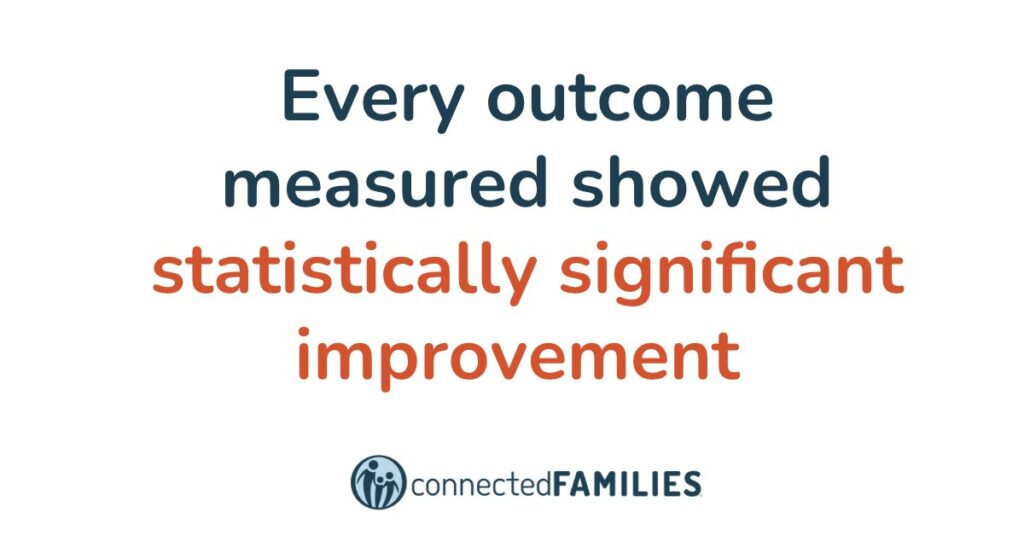
Phase One of our research project is complete, and the findings are the first formal evidence that the Connected Families Framework™ does what we’ve long believed it does. In an independent pilot study by The Florida Center for Prevention Research at Florida State University, parents who completed the Discipline That Connects With Your Child’s Heart online course reported a 49% reduction in coercive responses like shouting and shaming, and a 52% improvement in parent-child connection. Every outcome measured showed statistically significant improvement. The executive summary has the full findings.
Below, Dr. Cindy Wilson, our Director of Education, Equipping, & Research, tells the story behind the findings, including how a ministry that always wanted to be research-backed met a researcher already searching for a biblically grounded, research-informed parenting framework.
I am a Christ-follower first and a family scientist second. That order matters to me, though I will admit both parts of my brain tend to talk at once.
For more than 20 years I have worked in ministry and in academia, which means I have spent a lot of Sundays with people who love Jesus and a lot of Tuesdays with people who love data. I loved both worlds. I also kept noticing they rarely shared a table.
A few years ago, I started praying about what was next. I felt drawn to becoming a certified parent coach, so I looked for a training program. I had a specific wish list. I wanted a program grounded in Scripture that also took seriously what we know about how children develop and about how parents shape their children’s outcomes, and more importantly, their hearts.
In my search for a parent coach certification program, I read many websites. Some programs were rich in Scripture and had nothing to say about research in child development or parent influence. Other programs were thoughtful and rigorous in their research, but lacked a Scriptural base. I kept scrolling.
Then I found Connected Families.
Here was a ministry teaching parents the Gospel in the middle of the laundry pile, and doing it with a working knowledge of brain science, attachment, and trauma-informed care. It spoke to my heart and my brain at the same time. I may have said something out loud to my laptop, something along the lines of “where have you been all my life?”
Then, through a series of events I can only call divine providence, I had the opportunity to join the staff at Connected Families while keeping my academic position at Florida State University. The full story of how that came together deserves its own blog post. The short version is that I stopped scrolling and started working here.
What I learned after joining is that Connected Families had been sitting on a beautiful problem.
Twenty-plus years of stories. Parents writing in to say a relationship had been restored, an angry household had gotten gentler, a kid who felt like a problem had started feeling like a cherished child of God. Gorgeous, moving, and completely unmeasurable.
What was missing was data.
Connected Families had wanted harder evidence for years. Meanwhile, I had spent two decades wishing a parenting ministry would take Scripture and science seriously at the same time. Esther comes to mind. “For such a time as this,” though my version involves far fewer palace intrigues and considerably more time in survey software.
So let me tell you a little about what I have been up to since I got here. I helped launch our Ministry Partnership Program, I now serve as Director of Education, Equipping, and Research, where I oversee our Parent Coaching Certification program, and I am building out our research and evaluation work. This post is about that last piece.
What Makes a Parenting Framework Biblically Grounded
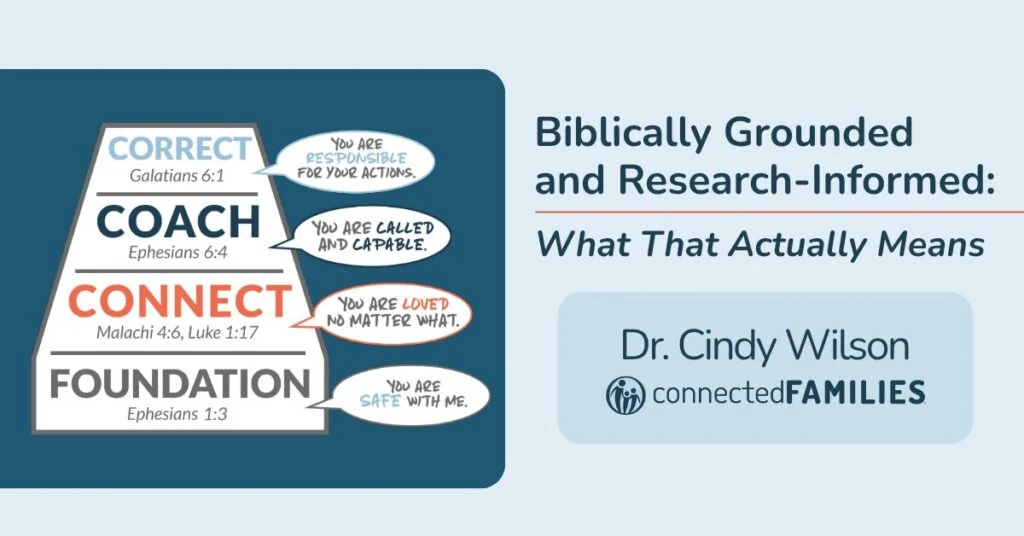
Everything we teach starts with Scripture. The Connected Families Framework™ is built on four messages every child needs to receive from a parent’s words, tone, and body language:
You are SAFE with me.
You are LOVED no matter what.
You are CALLED & CAPABLE.
You are RESPONSIBLE for your actions.
Those four messages encapsulate the Gospel, translated into the language of a Tuesday morning when nobody can find their shoes and someone has strong opinions about socks. God meets us with safety. With love we did not earn. With a purpose He assigned before we were born. And with a steady invitation to own our choices and grow.
When parents hand their children those same four gifts, discipline starts looking a lot like discipleship.
Being biblically-rooted also shapes what we refuse to promise. We will never tell you your children will stop melting down. Or that you will be a perfect parent. I have a Ph.D. in Family and Child Sciences, and I still lose my patience with my grandkids. We offer wisdom to see what lies beneath the behavior, and peace that holds while you stand in the hard moment.
How Child Development Research Supports Biblical Parenting
Some faith-based ministries treat research with suspicion. We do not.
Here is my theology of data, and it fits on a napkin. Research, done honestly, has one job. It reveals what is true. God’s Word is ultimate truth. So honest inquiry into how children grow and how parents influence children’s outcomes will keep circling back toward Him, whether or not the researcher intended it.
But the order of things has always been the same, and it is the part I most want parents to understand.
Scripture is our primary source. Research reinforces it.
We do not read the child development literature and then go looking for verses to match. We start with what God says about how He parents us, and we build from there.
What we have found is that the research keeps confirming what Scripture already established. Brain science affirms why safety has to come before correction. Attachment research supports why unconditional love changes a child’s willingness to be influenced. Trauma-informed care reinforces why a child’s hardest behavior so often signals an unmet need rather than defiance. God said it first. Researchers keep discovering the mechanism underneath it.
When neuroscientists explain that a calm adult nervous system helps settle a dysregulated child, they are describing exactly how a gentle answer turns away wrath. Proverbs got there thousands of years before the brain scans.
Research did not build our foundation. God’s Word is our foundation. But research reinforces the foundation and gives us additional language to explain it to parents who want to know why this works.
We keep reading, and we keep updating.
Our content team and coaching staff stay current with the field, and that shows up in how we actually build things. Any time we develop something new, whether it is a course, a coaching module, or a blog post like this one, we start in Scripture. We ask what God says about the thing we are trying to teach, and we let that shape it. Only then do we go to the research and ask what the current literature says about that topic.
That order is not a formality. It means Scripture decides what we teach, and research sharpens how we teach it. If the two ever seemed to point in different directions, that is a signal to slow down and study both more carefully rather than pick one. Twenty years in, I have not run into that yet. What I keep running into instead is research that gives me language for something the Bible already said.
And when the field learns something better, our materials change. Our trauma-sensitive approach exists because the literature on adverse childhood experiences reshaped what responsible parenting education has to account for.
We use the ingredients found in programs that work.
Our courses were designed with a set of common features that prevention scientists have identified as showing up in effective programs (Nation et al., 2003): enough dosage to matter, real skill practice instead of information dumps, serious attention to the adult’s own growth, and cultural fit.
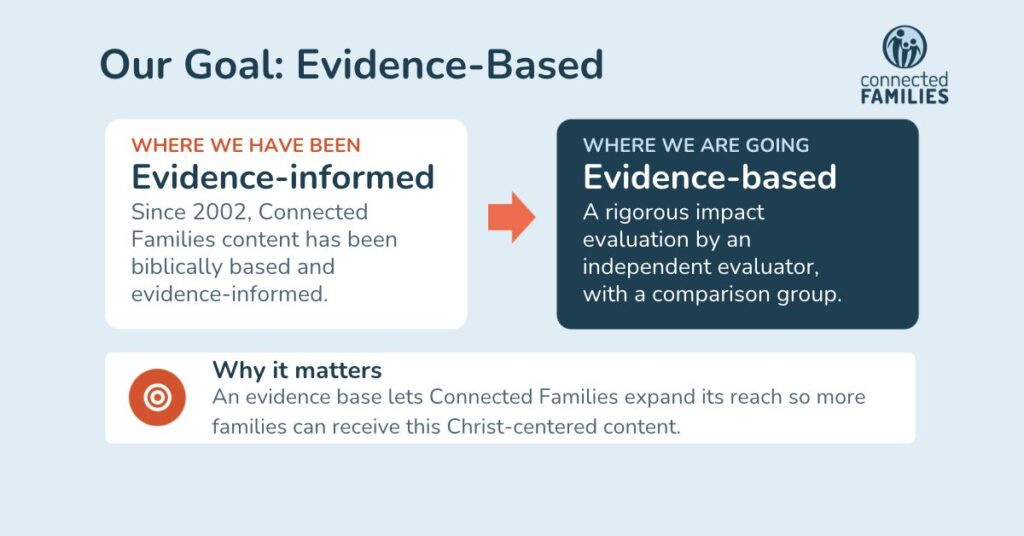
All of that makes us research-informed. But not evidence-based yet.
Research-Informed vs. Evidence-Based: What’s The Difference?
These terms get swapped around constantly, often by well-meaning people.
In prevention science, an evidence-based program is one that has been evaluated through rigorous research designs, has demonstrated meaningful positive effects on the outcomes it set out to change, and has documented procedures so others can deliver it the same way and achieve similar results. In practice, that usually means comparison groups, peer-reviewed publication, and replication beyond the original developers.
Evidence-informed sits one step earlier on that road. An evidence-informed program draws on credible research, applies known principles of effectiveness, and pays attention to what its field has learned. It has not yet completed the testing required to claim proven outcomes.
Connected Families is evidence-informed today. We intend to be evidence-based tomorrow. (‘Tomorrow’ being a research term that means several years, which is how you can tell scientists wrote it.)
That goal puts us in a genuinely unique position. Christian parenting resources are typically rich in Scripture but lack rigorous outcome data. The programs that have earned evidence-based status are almost entirely secular, built and tested outside of any faith framework, with the gospel absent by design. Very few resources hold both. Families deserve both, and we are willing to do the slow, unglamorous work of earning that second claim.
What a Logic Model Is and Why Program Evaluation Needs One
Before you can measure whether a program works, you have to say out loud what you think it does and why. Otherwise, you end up measuring whatever happens to be easy to measure, which is how organizations end up bragging about email open rates.
That is what a logic model does. Ours lays out a simple through-line:
- We deliver the Framework through courses, coaching, books, and free resources.
- The Framework teaches that parents grow first. In knowledge. In skills. In faith. In their own self-regulation. That growth improves parental well-being and teamwork between caregivers. It changes day-to-day parenting behavior.
- Those changes reshape the parent-child relationship and the health of the whole family, and children carry it into the next generation.
Parents change first. Everything else follows from that.
Good program evaluation starts with a clear logic model. Every survey question I write traces back to a box on our logic model. You can see the full Connected Families logic model here.
Inside the Florida State Pilot Study of Discipline That Connects With Your Child’s Heart
Building an evidence base takes years. We have officially started, and I have officially become the person who gets excited about response rates.
We ran this first evaluation with The Florida Center for Prevention Research at Florida State University, which specializes in exactly this kind of work. It also happens to be where I work (in addition to my role at CF).
I would call that another providence moment. I should, however, be clear about how we handled it. Because of the obvious risk of a conflict of interest, I stayed completely out of the data. I did not collect it, analyze it, or interpret it. An independent researcher ran the analysis, and I read the results the same way you are about to.
Here is what they did. Fifty parents who had finished the Discipline That Connects With Your Child’s Heart online course took a survey within six months of completing it. They rated where they are today and, in the same sitting, rated where they were before the course, using published survey questions and measures that researchers have already tested for accuracy. Then they answered open-ended questions, in their own words, about what changed at home.
That combination is the part I love. The numbers tell you how much moved, then the parents tell you what it’s like in day-to-day life.
Two things worth saying plainly before the results. This was a first study with a modest number of parents, and everyone was reporting on themselves. It is a starting line, not a finish line. That said, every single outcome we measured improved, and every one of those improvements was statistically significant, which is the researcher’s way of saying the change is very unlikely to be just noise.
Here is what we found:
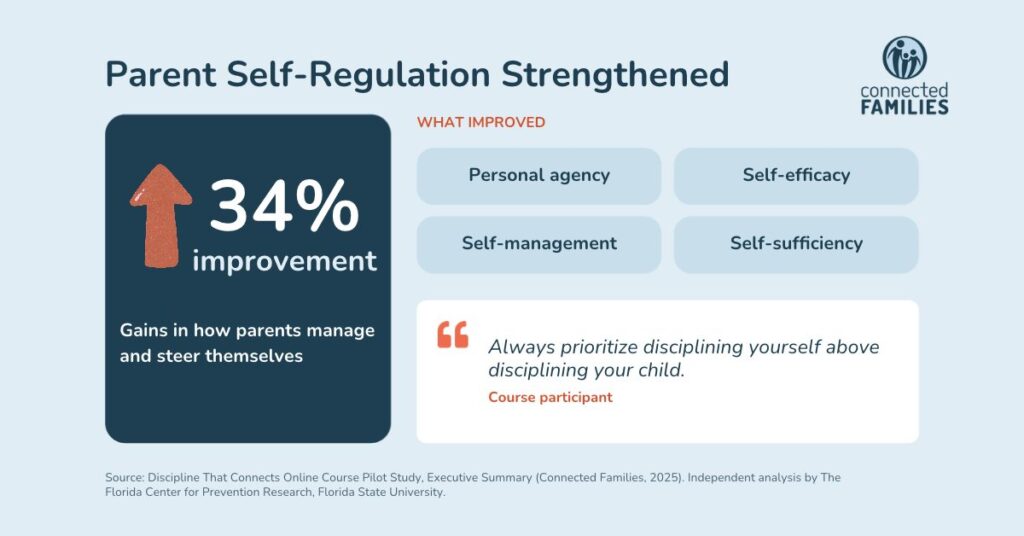
Finding 1: Parent Self-Regulation Improved 37%
- Self-management, staying regulated when your child is not: up 37 percent
- Personal agency, a parent’s sense that what they do actually matters: up 28 percent
Parent self-regulation is the hinge of our whole logic model, so I looked at this number first. When parents described the same change in their own words, almost none of them used the word regulation. They talked about anger.
“My responses: less anger, able to be calm and a safe place for her needs.”
“I went from being overwhelmed and anxious… to being usually calm and humble.”
Finding 2: Parenting Confidence Rose 39%
- Self-efficacy, believing you can handle what your child brings you: up 39 percent
- Self-sufficiency, having something left in the tank instead of running on empty: up 34 percent
When we asked parents how their perspective on parenting had shifted, the most common theme was self-awareness. They described becoming more reflective, more thoughtful, and more prayerful before responding.
“This course was huge in my personal transformation.”
“It helped me calm down and think before responding so I don’t react.”
Finding 3: Coercive Parenting Dropped 49%
- Coercive parenting, the yelling and threatening we slide into when we are depleted: down 49 percent
- Parental consistency, following through the same way twice: improved 36 percent
The open-ended answers explain how that happened. The dominant theme across all questions was a move away from control-based parenting and toward grace-based parenting: away from fear, anger, and compliance, and toward patience, empathy, and curiosity about what was driving the behavior in the first place.
“Treat your child like an actual person who has feelings and opinions… Discipline must be done in a way that cherishes and protects the connection with your child.”
“We are less anxious… as we know him better and we can handle his behaviors.”
“Always prioritize disciplining yourself above disciplining your child.”
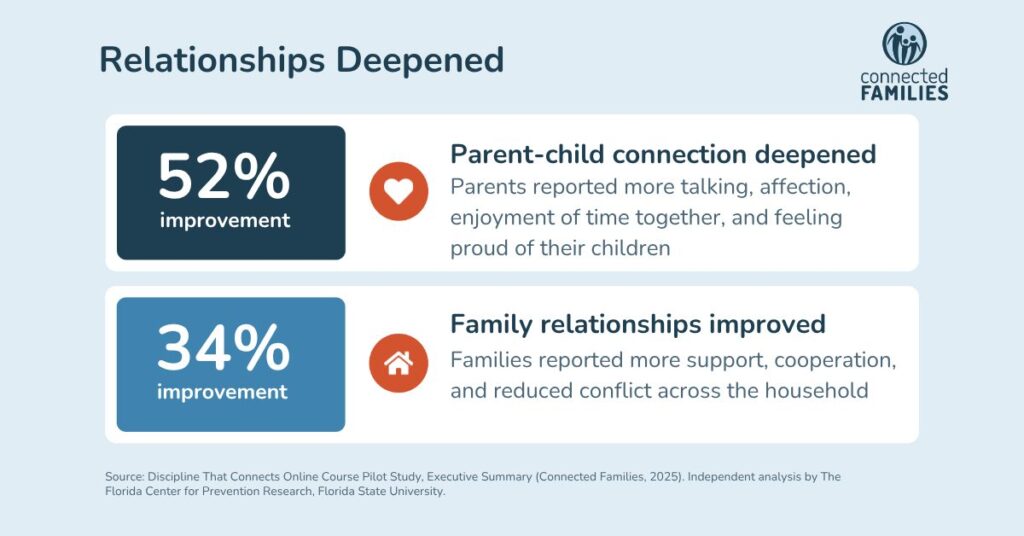
Finding 4: Parent-Child Connection Improved 52%
- Parent-child relationship: improved 52 percent, the largest change anywhere in the study
- Family relationships overall: improved 34 percent
- Parental adjustment, a parent’s own stress, discouragement, and anger: improved 39 percent
- Teamwork between caregivers: improved 32 percent
Asked how the relationship with their children had changed, parents described a stronger emotional connection, more enjoyment of each other’s company, and noticeably less anxiety about handling difficult behavior.
“We connect more, enjoy time together, and get along better.”
“Many of the things that were annoying me about my child were actually qualities that I also had.”
Finding 5: What Parents Noticed in Their Children
We did not measure children directly in this study. We asked parents what they had noticed at home, and three themes came back:
- A visible sense of safety that showed up across settings, not just at home
- Calmer children who could name what they were feeling
- More cooperation, more helping, more empathy toward other people
“As my behavior has changed, so has my daughter’s.”
“She feels safe to express and discuss things with me.”
“My child has been much more helpful and loving when I implement ‘you are safe with me.’”
What This Research Means for Your Family
If you are the kind of parent who wants to know where a claim comes from before you trust it, you now know exactly where ours come from and what we can honestly say today. I respect that instinct. I share it. Ask us hard questions.
But here is what I also hope you take away.
If you are tired tonight, if you replayed a hard moment on the drive home, if you have wondered whether anything you do is landing, if you are already dreading tomorrow morning, the data has something to say to you.
Fifty parents just like you sat down, did the work, started with their own hearts, and watched their relationships with their children change. Not perfectly. Not without hard days. But measurably, in the direction they were hoping for, and in ways they were still living out months later.
That is not a marketing claim. That is what parents told an independent research team happened in their own homes.
Here’s what still gets me, 20 years into studying families. The most powerful thing in a child’s life is not a technique or a curriculum. It is a parent who keeps showing up, keeps growing, and keeps coming back after the difficult moments to say “I love you, and we are okay, because Jesus is with us.” God designed it that way. The research just keeps confirming what He already told us.
So take heart. That small step you are considering, the one that feels like too little, too late, is exactly where God tends to start. He is already at work in your kitchen and in your kids. We just get to walk alongside you as He does.
See the Executive Summary of this study here.
Sources
The published research and validated measures behind this post, for anyone who wants to look them up.
Hamilton, V. E., Matthews, J. M., & Crawford, S. B. (2015). Development and preliminary validation of a parenting self-regulation scale: “Me as a Parent.” Journal of Child and Family Studies, 24(10), 2853–2864. https://doi.org/10.1007/s10826-014-0089-z
Little, T. D., Chang, R., Gorrall, B. K., Waggenspack, L., Fukuda, E., Allen, P. J., & Noam, G. G. (2020). The retrospective pretest-posttest design redux: On its validity as an alternative to traditional pretest-posttest measurement. International Journal of Behavioral Development, 44(2), 175–183. https://doi.org/10.1177/0165025419877973
Koenig, H. G., & Büssing, A. (2010). The Duke University Religion Index (DUREL): A five-item measure for use in epidemiological studies. Religions, 1(1), 78–85. https://doi.org/10.3390/rel1010078
Nation, M., Crusto, C., Wandersman, A., Kumpfer, K. L., Seybolt, D., Morrissey-Kane, E., & Davino, K. (2003). What works in prevention: Principles of effective prevention programs. American Psychologist, 58(6–7), 449–456. https://doi.org/10.1037/0003-066X.58.6-7.449
Sanders, M. R., Morawska, A., Haslam, D. M., Filus, A., & Fletcher, R. (2014). Parenting and Family Adjustment Scales (PAFAS): Validation of a brief parent-report measure for use in assessment of parenting skills and family relationships. Child Psychiatry & Human Development, 45(3), 255–272. https://doi.org/10.1007/s10578-013-0397-3
Wilson, C. B., Turner, K., & Zhang, Y. (2026). Preliminary evaluation of the Discipline That Connects online parenting course: Evidence for a scalable, theory-driven parenting intervention [Conference presentation]. National Council on Family Relations Annual Conference.