🎧 Prefer to listen? Listen to this as an audioblog!
If your child struggles with separation anxiety, you know all about the dreaded drop-off. You know about the preamble—the slow dressing and eating, the extra hugs, the little comments from your child about hurting bellies or fevers. And then comes the culmination: the drop-off. When dropped off, your child’s fear of school, preschool, or daycare climaxes in excruciating screams.
It might look something like this:
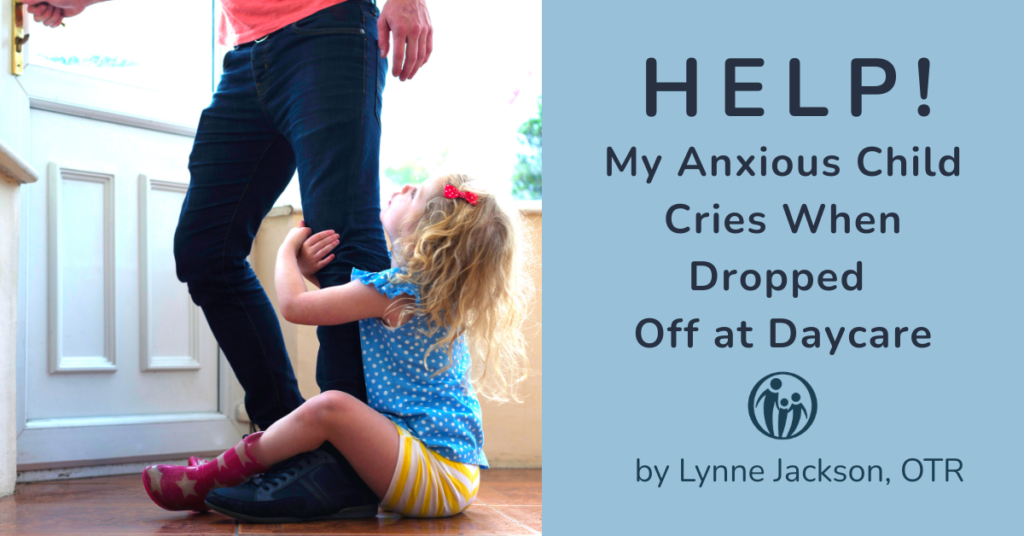
“Nooooo, Mommy, noooooo! Don’t GO!” your little one wails, fastened to your legs.
You might wonder, “Why is my child the only one who becomes hysterical whenever I try to drop her off?”
Table of Contents
Is it normal for a young child to cry at daycare or school?
First off, yes, it’s normal. It’s normal for your young child to cry at daycare or school, particularly when you drop them off. It doesn’t mean you’re a terrible mom or dad. It’s a combination of solid attachment and God’s gift of their brain’s protection system. (It’s meant to keep them from wandering off from you when it’s not safe.) Your child may have some extra sensitivity or anxiety, making this more intense than most kids.
Children go through predictable phases of separation anxiety. For example, babies often experience separation anxiety around seven months. This usually improves before their first birthday. Many other children have another phase between 18 months and 2 ½ years of age.
That said, it’s important to also realize life changes can bring about new struggles with separation anxiety, regardless of your child’s age. Maybe your child never felt separation anxiety as a baby and did great with daycare. Still, it’s perfectly normal when they start a new school to suddenly experience separation anxiety and an unprecedented fear of school. Likewise, a new baby sibling or a parent’s divorce could also trigger separation anxiety. All of these things could lead to crying at daycare or school.
It’s also normal if they don’t experience separation anxiety and absolutely love leaving you to go to school. That doesn’t make you a bad mom or dad, either—strong attachment can be the source of exploration and social confidence. Different kids respond to life events in different ways.
When separation anxiety signals a need for help
However, there are times when separation anxiety may hint at a need for extra support. Some children (approximately 4%, or 1 in 25) struggle with separation anxiety disorder.
While all of the recommendations in this article will hold true for children struggling with separation anxiety disorder, they may also need additional professional support. More severe separation anxiety in kids can sometimes lead to other adult anxiety disorders unless parents seek professional help.
If you notice your child’s separation anxiety is getting in the way of enjoying life (not just at school dropoff, but during the school day as well) or interfering with sleep (for example, due to nightmares about losing a loved one), seek professional help.
What feeds the fear of school?
I have coached numerous parents of kids with separation anxiety. Aside from personality, specific underlying issues can feed separation anxiety:
- Family stress: A chaotic family schedule or outside source of stress can create insecurity and hinder quality, joy-filled attention from a parent.
- Sensory: A child’s unique sensory sensitivities can make busy or less familiar environments over-stimulating or increase anxiety at daycare drop-off or in a new classroom.
- Parents’ anxiety or guilt about their child’s distress at school drop-off inadvertently sends a nonverbal message, “You should be upset. I’m doing a terrible thing by leaving you!”

How this mom helped her son face his fear of being dropped off
The following story of a coaching family’s success offers many practical strategies for other families struggling with this challenge.
Suzy shared that her son Ethan had such intense separation anxiety that her participation in Bible studies and church nurseries was “an absolute and epic fail.” By the time he was three, Suzy and her husband Rob sought out parent coaching for the intense, prolonged crying and clinging. Ethan had all three issues going on:
- Family stress: His parents utilized several kinds of childcare to manage demanding and unpredictable schedules.
- Sensory sensitivity: He was born at 28 weeks, resulting in sensory sensitivities and increased anxiety.
- Parents’ anxiety/guilt: His mom expressed that she felt very bad about Ethan’s premature birth and its impact on him. This guilt and anxiety caused her to be filled with angst instead of confidence and joyful connection during separation times.
As we talked, Suzy and Rob shifted their primary goal from easing the stress of drop-offs to learning ways to help Ethan feel truly safe! This may seem like a minor shift in perspective, but it’s significant because kids can sense the differences in our motivation. They learned to tune into the cues that Ethan would give when he was becoming overwhelmed. That helped them find creative and empowering ways to support him using many of the tips below.
We have a podcast on this topic!
Check out Episode 143 of our podcast, “Is Your Child Crying at School or Daycare Drop-Off?” To hear more about this challenging issue and be equipped with more practical ideas.
Ideas to help your child detach without crying at drop-off
You can develop a thoughtful plan for each of the three underlying issues to help your child face their fear of school and childcare more calmly and confidently.
The list below is extensive. Prayerfully consider which ones are right for your child.
1. Decrease overall stress: Make life more predictable and connected
- Reduce the frequency and number of different environments in which your child has to separate by adjusting your schedule, if possible. The more chaotic life feels, the more threatening separation will seem to a child.
- Choose more controlled and predictable settings to initially practice drop-off transitions. To build success, you may want to avoid church nurseries or high-energy friends’ or cousins’ homes at first and choose safe, known people until your child is more comfortable leaving you.
- Make a weekly calendar with pictures of key people your child would see throughout the week to help him anticipate events. You might laminate the faces of caregivers and put sticky Velcro on the back to easily move their pictures to Velcro strips on different days. (This is especially helpful if a parent is traveling.) If it’s possible, meet your child’s teacher ahead of time and take pictures.
- Have your child make a list of favorite activities to do with these caregivers, either with pictures or you write it down for them. This will help him look forward to those times.
- Use symbolic play to help your child process difficult emotions. When you’re playfully engaged with your child outside of school, you can enact a drop-off scenario with your child’s stuffed animals, puppets, dolls, or small figures. Give your child space to take over the storyline. Kids might be unable to remember and verbalize how they felt at drop off, but of course “dolly” is scared when her mommy leaves because what if Mommy doesn’t come back?! You can also problem-solve with your child: What could dolly do to feel better when her mommy leaves? Working through “dolly’s” anxieties with your warm, reassuring presence can help your child integrate those memories in a helpful way.
One mom shared how she helped her 3-year-old daughter, who screamed and chased after her every day when it was time to line up to go into preschool:
“I lined up her stuffed animals, designated one as my daughter, and then did a ‘reenactment’ of what I saw. I asked her how everybody was feeling: the other kids, the teacher, the Mommy, and her stuffy. That opened up a floodgate of fears she was having about school, and we talked and talked! Then we played out a calm, helpful way to line up for preschool. It has just been a few days after our role-play talk, but her anxiety has dramatically improved! Lining up with no tears or tantrums! Yay!!!”
- Focus on positive memories during bedtime talks: their experiences and the good things they did. This empowers their brain to sort and process memories from the day in the most helpful way. You can also help your child anticipate the good events coming up the next day.
- Include some special 1:1 time in your morning routine. Whether a caregiver is coming to the house or you are leaving for school, set a timer and spend 5-10 minutes of 1:1 time before that transition. This can be a special time to talk, pray, listen to a favorite song—whatever your child wants to do, or just be together. Practice the timed “Dad & me” or “Mom & me” connection outside of morning transitions so your child learns to enjoy that time without becoming overly upset when it ends.
- Increase your child’s big-muscle activity because big, rhythmic movement is the “great arousal regulator of the body.” Hopefully, the school or daycare you’ve chosen provides lots of opportunities for that. If not, it will help to work more of that into your days in the first few weeks of school or daycare.
- Make the first few days shorter if possible. Studies show that young children in daycare have cortisol levels that continually rise throughout the day rather than fall, despite the lack of detectable external distress.
2. Calm the Chaos: Adjust the sensory experience at drop-off
- Provide regulating activities beforehand. You might sing a favorite song as you stomp your way into the building (rhythmical marching and stomping can be calming), or you might spend a few minutes playing together on the playground first.
- Your child can choose one thing to bring with them each day. Moving through all the different environments to get to preschool or school can be overstimulating and stressful. A “transition item” is a calming central focus for a child. Double win if they made something to give to their daycare provider/teacher that they are excited about (i.e., a picture or a treat). That builds confidence and connection with the teacher.
- Avoid coming when all the other kids arrive, as it can be very overwhelming. Consider whether your schedule allows some flexibility. Showing up before or after the “entrance stampede” and the settling-in commotion allows your child to enter a calmer environment.
- Guide care providers to provide a calm welcome. A loud, high-energy response from a caregiver can be overstimulating. If it’s a little chaotic in the room, step off to the side to make that connection with the teacher. Gentle playfulness is helpful.
- Provide a purposeful, initial activity that connects your child to others. Arrange for your child to regularly do a helpful task when they first arrive, giving them an immediate focus and purpose. Kids feel more confident if they know they can be a blessing to someone else. Or, ask the teacher if an easy-going or compassionate child could be your child’s “buddy” first thing in the morning.
- Alternatively, if your child needs space before joining whole-group activities, arrange for your child to do something alone right after you leave. This could be flipping through a picture book from home at the back of the room, or another quiet, non-disruptive activity.
- Help your child regulate after school/daycare with sensory-rich activities, to put a positive end to their experience there. See this article for details.
3. Be confident and connected: Replace guilt and anxiety at separations

Note: Play and laughter powerfully reduce anxiety. “…research [in hospitals] found that children exposed to the merry jesters were significantly less anxious during subsequent medical procedures, regardless of whether a parent was present, and experienced improved psychological well-being.” So here are a couple of practical ways for you to be the “merry jester” to help your child feel safe and do well with or without you.
- Before you leave, playfully pursue your child to help them feel secure and loved. Try a few minutes of play where you pursue your child while practicing separation: peekaboo, chase, tag, hide-and-seek, and look for the child as you pretend you can’t see them. Wildly celebrate finding or catching your child. This communicates, “I want you! You are delighted in!”
- Engage in power reversal play to build your child’s confidence. You become the silly, clumsy, confused, or frightened adult that needs your very competent child! Start to put your jacket on your child and theirs on you until they set you straight. Let them use your thumb as a joystick while you bump into walls on the way to the car. Forget their teacher’s name and look for Mrs. Magilicutty instead, and then walk into a bathroom (instead of their classroom) looking for her.
- Especially on the first day, engage in an initial activity with your child (if allowed by school rules) until he enjoys it and connects with a teacher or another child, even if the teacher insists your child will be fine. Kids may not understand why they are being left behind, and research indicates that the pain of feeling rejected resembles physical pain. Staying to play decreases the likelihood your child will feel rejected when you go.
- Be calm and lighthearted when it’s time to leave. Don’t damage trust by sneaking out when your child is distracted! If your child still seems worried, you can smile and sincerely say, “Sometimes it’s hard when I leave, but Mrs. Smith can hold you, and soon you’ll be having fun!” as you pass your child to the arms of a caring teacher who will hold your child until he calms down.
- Have a transition routine. Maybe it’s a hug, followed by a high five; perhaps you have a secret handshake and/or pray a strong blessing over your child. Whatever it is, keep it fun and fairly short, and do the same thing every day. Anxious kids thrive on predictability. Practice at home first.
- Let your child know exactly when you’ll be back. Even if they can’t tell time, your confidence will help them. (“See you at 2:30!”) Little notes in their backpack or lunchbox can offer love and reminders about pick-up time.
- Equip care providers to notice and affirm how your child self-calms. They can pay attention: What action did your child take to settle down, and how was that helpful? Then they can explain it and help your child feel good about his accomplishment.
After you’ve adjusted your approach, if your child still seems highly anxious at drop-off or shows a general increase in anxiety and challenging behavior, you may want to reconsider if preschool is a “just-right-challenge” now. If you have the option to either have a nanny come to your home or simply discontinue daycare/preschool for now, that could be the best decision. You can disregard any pressure you may feel for your child to “be like all the other kids” who love preschool. A little more brain maturity can go a long way. You can focus on suggestions 1 and 2 and try again another time.
What does it look like when your child overcomes their fear of school and separation?
This effort resulted in Ethan completing two years of preschool and entering kindergarten the following fall. Suzy shared some profound insights:
“Ultimately, I have recognized this ‘inconvenience’ with our precious son as a sign that he is a deep connector and establishes trust and authenticity with key people in his life. Once he feels known and understood, he can more easily succeed in different environments away from us. Any child that struggles to be released from mom or dad has underlying needs that simply need to be attuned to properly, and when that is done – the child will thrive in a way that builds great confidence and joy! They will be prepared to utilize their deep, God-given sensitivity, to be highly compassionate to those around them.”
(Don’t miss this corresponding podcast where Suzy shares their experience and Ethan’s progress from a years-later perspective!)
Reflect on how you can help your child’s drop-off go better
Instead of being critical and anxious about your child’s fear of school, how could you:
- Make life more predictable and connective?
- Meet your child’s sensory needs for calm environments?
- Let go of your anxiety and connect well when it’s time to separate?
- Help your child channel their God-given sensitivity toward compassion for others? (a nice gift for a teacher or caregiver, encouraging another student, etc.)
Trust that God will guide you about what is right for your child. Based on how Jesus treated children, we are pretty sure He will want to give you wisdom!
If any of you lacks wisdom, you should ask God, who gives generously to all without finding fault, and it will be given to you. — James 1:5
Frequently Asked Questions (FAQ) About Separation Anxiety at Daycare
Is it normal for my child to cry at daycare drop-off?
Yes. Crying at drop-off is a normal sign of healthy attachment and your child’s built-in protection system. Many children go through predictable phases—often around 7 months, and again between 18 months and 2½ years. New situations like starting school, a new sibling, or a change in the family can also bring it on at any age.
How long does separation anxiety at daycare usually last?
It varies by child. Early phases often ease within a few weeks as your child adjusts and builds trust in the new setting. Consistency, a predictable routine, and calm, confident goodbyes usually help it fade faster.
Should I sneak out to avoid the tears?
No, we don’t recommend that. Sneaking out can damage your child’s trust and make anxiety worse. Instead, use a short, predictable goodbye routine, stay calm and warm, and let your child know exactly when you’ll return.
What can I do to make drop-off easier?
Try lowering overall stress with a predictable schedule, adjusting the sensory environment (arriving before the crowd, bringing a comfort item), and letting go of your own guilt so you can offer calm, confident connection. Playful goodbyes and a consistent transition routine help too.
Why does my child seem to have worse separation anxiety than other kids?
Every child is wired differently. Some children are more sensitive or feel emotions more deeply—often a sign they’re deep connectors who build strong, authentic bonds. With attuned support, this same sensitivity can grow into compassion and confidence.
When is separation anxiety a sign my child needs extra help?
About 1 in 25 children experience separation anxiety disorder. Consider seeking professional support if the anxiety interferes with daily life beyond drop-off, disrupts sleep, or causes nightmares about losing a loved one.
How can I stay calm when my child is crying and clinging to me?
Remember that your calm helps your child feel safe. Keep goodbyes short and lighthearted, hand your child to a trusted caregiver, and trust that the tears usually ease soon after you leave. Your confidence sends the message: “You are safe here.“
Does daycare separation anxiety mean I’m making the wrong choice?
Not at all. Tears at drop-off don’t mean you’re a bad parent or that daycare is wrong for your family. If anxiety stays intense after you’ve adjusted your approach, it’s okay to reconsider whether the current setting is the right fit for now—and try again when your child has more brain maturity.
© 2023, 2026 Connected Families