
Knowing when to stand firm as a parent and when to extend mercy can be a difficult challenge. And even if you’ve figured out it’s time for firmness, you still need the determination and focus to follow through in the face of strong resistance from your kids!
If your parenting style leans towards permissive parenting (high warmth but low limits), read on for grace-and-truth-filled help on what might be going on under this tendency and how to move towards the authoritative parenting (high warmth and firm boundaries) style that both the Bible and brain science support.
Am I too soft? Move from Permissive to Authoritative Parenting
Have you heard yourself say these things to your kids?
- “That is not ok, do you understand me? How many times do I have to tell you?”
- “If you finish your chores, I’ll get you a bowl of ice cream.”
- “Ok, I’ll let this go this time, but next time there will be a big consequence.”
- “You never listen to me!”
There’s no shame in this. If you often find yourself backing down, offering bribes, or making empty threats when you want to stand firm, you’re not alone. Lots of parents struggle with this, and there is so much grace available to you.
The hard truth is: if parents regularly give kids unhealthy power by being overly permissive and not following through, it can have a significant impact over time. Research shows kids will use this power on others as well because both harsh and passive parenting increases a child’s likelihood of bullying others.

Why authoritative parenting is the sweet spot for parenting healthy, wise kids
Parenting styles can have lasting impact on children. Here are four parenting styles and what research finds are their outcomes:
- “Permissive parenting” is high on warmth but low on limits and/or follow-through.
- It often falls short of God’s calling for parents to help children see their responsibility for their actions, and ultimately, their life.
- Children may become egocentric, lack focus, and show poor self-discipline.
- “Authoritarian parenting” is characterized by low warmth and high control.
- It often prioritizes compliance over building wisdom and character
- Children may develop reduced self-esteem and increased mental health problems like anxiety and depression.
- “Neglectful parenting” is uninvolved parenting with low warmth and low structure.
- This is disobedience to God’s clear instruction to parents in Ephesians 6:4 to “not exasperate your children” and to “bring them up in the training and instruction of the Lord.”
- Children often show the lowest academic achievement and are at a higher risk of self-harm and substance abuse.
- “Authoritative parenting” is characterized by being kind and firm. It’s caring with authority, collaborative problem-solving, and limits.
- Not only does this style model Jesus’ style of authority in the Gospels, and Paul’s instructions to “gently restore” in Galatians 6:1, this parenting model often builds wisdom in kids, and helps them learn to value restoration and reconciliation.
- Research shows this parenting style leads to improved academic achievement, self-esteem, social skills, and less anxiety, depression, and other mental health issues.
This is all quite the “case” for authoritative parenting! But how can you remain kind and firm when you feel overwhelmed by your child’s intensity and your family’s overall needs?
In habitual conflicts, there is almost always more going on than meets the eye. It could be that your kids know that, even if you try to appear strong, you may not be sincerely confident in your God-given authority.
But giving yourself a scolding, “C’mon, You gotta be the parent – stop being a pushover!” is not helpful. If it were that simple, you’d be standing strong, wise, and confident already. Internally calling yourself soft or a pushover only deepens that identity, which is not the identity you‘ve been given in Christ!
“For in Christ all the fullness of the Deity lives in bodily form, and in Christ, you have been brought to fullness. He is the head over every power and authority.” Colossians 2:9,10
To help you truly walk in your authority, let’s look deeper at what might be making it tough and what you can do.
How to shift your parenting style: 5 steps to be kind and firm
1. Anchor yourself in truth
What’s going on under the surface?
Parenting is rooted in a combination of personality, experiences, and beliefs about your kids and yourself as a parent. Turning over a few stones of self-awareness has proven to be helpful to many parents stuck in negative patterns.
If any of these issues (or others you identify) cause you to feel timid when trying to discipline, you can stand on the solid rock of God’s grace and truth for you and your kids.
Move from hurtful beliefs to helpful truths
In the grid below, you’ll see some hurtful beliefs with which you might identify and some helpful, empowering truths to replace them.
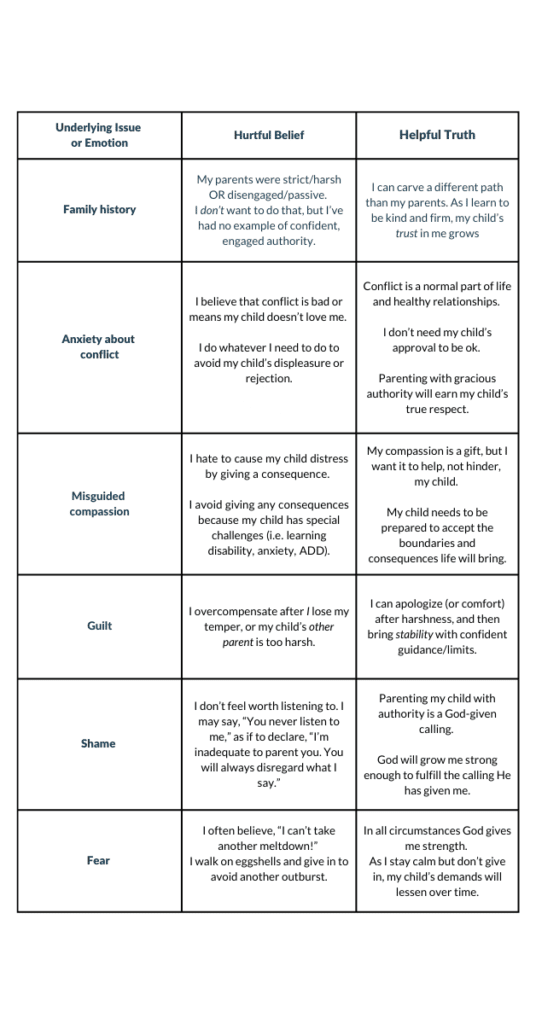
Do any of these hurtful beliefs sound familiar? What corresponding helpful truth is empowering to you?
You can print the PDF and circle or alter phrases as needed, or you can ask God to show you a very personal truth just for you. Keep those truths visible!
FREE PDF DOWNLOAD: “Hurtful Beliefs and Helpful Truths“
It is hard to overstate the importance of a strong sense of calling in your parenting. Having a passion for God’s purposes in your kids’ lives can give you peace when the lid comes off and determination when you want to give up or give in. That combination of peace and determination builds your kids’ trust in you.

It’s vital to remember that God will be with you in this, just as He was with many people who felt inadequate. The nation of Israel had tested God and the authority He had given Moses many, many times. Then Moses died suddenly. Joshua didn’t even have time to grieve, but was thrust into leading these two million contentious Israelites. God did not tell him it would be easy! But note what He did promise: “As I was with Moses, so I will be with you; I will never leave you nor forsake you. Be strong and courageous because you will lead these people to inherit the land I swore to their ancestors to give them,” Joshua 1:5b, 6.
God has called you to lead your children, and He will be with you just as He was with Moses and Joshua to lead Israel. May that help you stand firm in grace-filled strength when you feel like you might be “pushed over” by your children’s big energy and resistance to discipline.
With that solid foundation, let’s dive into some practical ideas!
2. Aim for “Kind and Firm”
In a calm and respectful tone, let your kids know you understand what it’s like to be them. Then offer two “you can…” choices with a clear boundary. This combination might look like this:
“I know you are tired after school and love to relax and play. I often feel that way after work. You can choose to get your chore out of the way and then play, or you can play now and do your chore before dinner. But it must be done when you come to dinner.”
If they give more pushback, stay calm, give them more empathy, and repeat the choices. No deals.
If this approach is new to your kids, they may fight it before they understand that you won’t change your mind. Stay calm and just let them know that you understand, but any emotional drama won’t hook you; your boundaries are firm! Once kids sense your confidence, they are far more likely to respect your authority.
Read How to Say “No” to Kids Without Power Struggles to help you set limits in a positive, encouraging way.
3. Have a Plan
A challenge nearly all less-assertive parents face is that, in the heat of the moment, it’s tough to come up with appropriate, constructive consequences. If you have a plan you feel good about, you’ll likely stay calm, stand strong, and follow through.
I was not a think-on-your-feet parent who could pull a wise response out of the air. I got overwhelmed by the chaos and found myself vacillating between being harsh and not following through. I decided to write down our common discipline challenges, and then, for each one, I prayerfully considered which values and skills I hoped to build in my kids. It bolstered my sense of calling in discipline, which was essential for me to respond with calm authority.
Over time, those ideas actually became the raw material for the Discipline That Connects With Your Child’s Heart book appendix. For example, here’s an excerpt from p. 212 on the subject of kids leaving messes:
A “make it right” consequence we used flowed from our vision to maintain a quickly hospitable home. We knew kids would need the skill of noticing and spontaneously cleaning things that were messy. If they left a mess in a common/hospitality area of the house, the consequence was to find a certain number of things that needed to be put away or cleaned and report back to the parent. This provided an opportunity to affirm and value their noticing and their diligence.
When you know your discipline is truly for your child’s good (not your own sense of control or justice), it is so much easier to implement confidently, and kids receive it so much better. If you’ve thought through your purposes well, then when the chaos starts, you’re ready! You’ll be less tempted to just give in when your child needs limits or accountability. You can even state your purpose and good intentions out loud:
- “Would I be a good parent if I didn’t teach you responsibility (or respect or…)?”
- “I want you to trust our rules and trust me.”
- “I know this is hard, but I care about you enough to stand firm on this.”
Even better than making all your own rules and consequences, check out our blog post on family meetings and develop these rules and accountability measures together. Ownership can lead to buy-in, which in turn reduces resistance. The agreed-upon rules can be the “enforcer,” not you.
Forgetful parents: make a plan to not forget your plan!
Speaking of having a plan, a discipline plan is only useful when you can remember it. If this is a big struggle for you, perhaps forgetfulness was a coping mechanism for you as a child, or maybe you’re just a bit forgetful about most things. Either way, if you struggle in this area, your kids will know it.
Karolyn told us about a recent discussion with her almost six-year-old about a consequence he would receive. He looked her in the eyes and confidently told her, “Mama, you’re going to forget anyway.” Ouch. (Honesty out of the mouth of babes!)
No matter how calm and thoughtful Karolyn was in the moment, her son was confident there’d be no follow-through. She wasn’t being overly lenient. She intended to set healthy limits, but… if she couldn’t remember the plan, what was the point? She began to use some practical strategies to strengthen her follow-through.
How to overcome forgetfulness in holding your child accountable:
- Creatively reduce offenses that just keep happening. You might be trying to keep track of too many “consequences in waiting.” It’s time to coach! If it’s a group issue, hold a family meeting as mentioned, or problem-solve with an individual child. You also could teach a positive value or skill that prevents misbehavior, using our motivate, model, practice, praise sequence.
- Give kids ownership of consequences. Listen to your child with grace as you work to problem-solve. They might even have some good ideas for a “make-it-right consequence” that will help them practice something helpful. The more they have ownership and are invested, the less likely they are to try to avoid a consequence.
- Put it in writing. A post-it note or notebook makes it easy to check your plan, including why a consequence is given. It’s pretty hard to follow through when neither you nor your child can remember why you’re doing something. (Just be careful not to shame your child by putting the record of their infraction in full view of everyone else.)
- Set a reminder. This might be with your “friend” Alexa, a phone timer, or even a note on the kitchen table to check if consequences have been completed before a child sits down at the next meal.

5. Breaks and Do-Overs
Even with helpful core beliefs, a goal of “kind and firm”, and a plan, things will still go unexpectedly awry. When that happens, take a break to think of an appropriate consequence. “I want to be thoughtful about this. I’ll let you know what I decide.” Taking time to think and pray models reliance on God’s wisdom and gives you time to become calm and confident. As one parent of a teen wisely stated, “The space between The Incident and The Conversation is a holy moment. It’s when I’m most tuned in to the Holy Spirit.”
If you realize you let something slide when your child needed firmness, you can give yourself a do-over. Perhaps you have responded in a permissive, anxious way rather than in an authoritative way. Here’s how a do-over might sound:
“I’ve given this more thought, and I’ve realized I made a mistake by letting this slide. In doing that, I undermined our family rules. You are aware that your behavior warrants a consequence, so that is what will happen.”
You can even let your child know ahead of time that you may do this in order to be a more thoughtful, trustworthy parent. As you discuss this, you can say something like, “Whether I’ve been too harsh or too soft when I respond to you, it’s ok for me to take time to reconsider. I want to be the best parent I can.”
For the story of a gentle parent who found the strength to stand strong in her authority, read Got a Demanding Child? This Mom Figured Out What to Do.
Whether your need is a deeper dive below the surface of your heart or simply some tools for a “kind and firm” approach to setting limits, either way, you can trust God to grow you in your confident authority.
Authoritative parenting: hold onto grace as you grow
No matter what, give yourself grace! You’re still going to have times of being forgetful or overly permissive, so just own it and tell your kids how you’re working on this without a load of shame!
And keep your successes in clear view: If you’ve remained safe and loving, if you’ve coached your kids, showing them that they’re called and capable, pause right there. Great work! That took a lot of intentionality and mental load. And maybe you used to yell or give reactionary, illogical consequences, and now, more of the time, you’re emotionally safe or more likely to give purposeful consequences.
Wherever you’ve grown, talk about that with your kids, and celebrate!! Your kids will have their own areas they’ll struggle to overcome. Be an example, and show your kids both your commitment to growth and your deep belief in the glorious abundance of God’s mercy that is ours.

Practical steps to stay confident:
- Anchor Yourself in Truth – Keep your helpful truths visible to “renew your mind.”
- Aim for “Kind and Firm” – Empathy and two “you can…” choices.
- Have a Plan – Develop purposeful consequences, or agree on them in a family meeting.
- Breaks and Do-Overs can help when it still goes awry.
2 Timothy 1:7 promises us, “For the Spirit God gave us does not make us timid, but gives us power, love, and self-discipline.” You love your child! That determined love will help you stand on your God-given identity as “called and capable.”
Be encouraged. You can learn to give your child guidance and set limits that will ultimately build trust in your relationship and foster appreciation for personal responsibility and the restoration of wrongs.
© 2022, 2026 Connected Families