



Should We Demand Immediate Obedience?

For a more in-depth look at requiring immediate obedience from our kids (and the possible pitfalls) please check out our expanded version of this article titled, “Should I Require Immediate Obedience from My Child?”
Do you require immediate obedience from your kids? Does God require immediate obedience from our children? What does the Bible say about obedience? My thinking on this topic has changed over time.
“Delayed obedience is disobedience.” Or so they said.
As a young dad, I listened to teachers who said, “Delayed obedience is disobedience.” Kids should be required to immediately obey all parental requests. That was the common thinking of the time.
I disciplined accordingly. I knew that having obedient kids was a good goal.
And, if I’m honest with myself, I liked the feeling of control and validation that came with having obedient kids.
When our kids disobeyed, I was quick to respond with a rebuke and a consequence.
Demanding immediate obedience just wasn’t working
Our oldest son, Daniel, was particularly strong-willed and defiant, and I was hard on him. But my approach didn’t have the desired effect.
As Daniel grew from a toddler to a preschooler, he became increasingly irritated by my discipline. He became angrier and testier with time.
What did I do? I intensified efforts to “nip this in the bud” by requiring more obedience. Not just any obedience. I required immediate obedience.
“Daniel, delayed obedience is disobedience, and you’ll be disciplined if you don’t obey immediately.”
I uttered these words again and again. Sometimes he complied, and sometimes he did not. We were both generally discouraged by the process.
At some point, I realized maybe I was actually more disobedient than Daniel.
What does the Bible say about obedience?
Yes, the Bible commands children to “obey your parents in the Lord” (Ephesians 6:1).
But there was a problem. I forgot there was a verse for me, too. I was working much harder on getting the kids to follow their verse than I was to obey the verse aimed at fathers a few sentences later.
It turns out that perhaps the most direct of all commands in the Bible to fathers is found in both Colossians 3:21 and Ephesians 6:4. In short, it says, “Fathers, don’t exasperate or embitter your children.”
We love how The Pidgin Bible paints a more vivid picture than our English Bibles: we are warned not to make our kids huhu (crazy)!
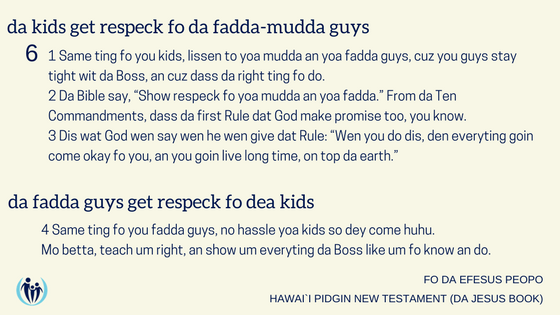
In my own “huhu” efforts to gain obedience, I was clearly disobedient. How?
My discipline stemmed from self-interest
I yelled. I stood tall in order to intimidate my kids into submission. I scared them into doing things my way. I sought to emerge victorious.
There was a subtle “I win and you lose” dynamic in my discipline. And I made “losers” of my kids.
I did little to consider what was really best for my children. Instead, I disciplined from a sense of what was best for me. In other words, much of my discipline was selfish!
The saddest thing about this is that two of my three kids largely complied when I acted this way. So I thought my quest for immediate obedience was working. What they were really learning was that submitting to angry people is the way to get along in life.
Since it was “working” with them, I was even more critical and harsh with Daniel. I remember saying about him, “This kid thinks he’s the center of the universe!”
I’m guessing, in retrospect, that if he had the skills at the time, he’d have said about me, “This dad thinks he’s king of the world!”
Although I was well-intentioned, by exasperating my three kids, I was sinning against those precious ones entrusted to me.
When teens demand an explanation, before obeying
Of course, little problems become big problems when little people become big people.
Nearly every day we coach parents who say, “I just want my teens to obey when I ask them. I don’t owe them any explanation.”
True, maybe, but…
I found myself acting on this thinking one day with my teen son. It was one of those arguments where I didn’t have time to think through my “No!” to him. I just said it so we could keep moving.
(It was back to discipline based on my needs again, in retrospect.)
I could feel a power struggle coming on, so I said, “You can spend as much energy as you want trying to get me to change my mind, but it won’t get you anywhere. I am NOT changing my mind.”
He decided to spend more energy anyway. “But I just don’t get it. You have no good reason!”
I finally played the “because I’m the parent” card and said, “This is one of those times when, because I’m your dad, my no means no. No questions asked, final answer!”
His next response shook me.
He was quiet for a moment and then, in a defeated voice, said, “Okay, Dad. You win.” He paused. I didn’t like how I felt. He then continued, “But if you want me to respect you, the way I want to respect you, you’ll help me understand your reasons better.”
He nailed it.
Daniel spoke for all kids when he spoke these words. Our kids deeply want to respect us. But if what they get is our frequent demands for obedience with little to no explanation, they have no good reason to respect us.
In this case, the only immediacy behind my “No!” was my need to feel in control. By not explaining, I was exasperating him and damaging our relationship. I had not really thought through my reasons and, upon further examination, discovered my reasons were somewhat selfish.
It turns out I did owe him an explanation, and that explanation helped me reach a more rational and mutual conclusion with Daniel.
Don’t make your kids huhu! (AKA, don’t exasperate them)
As we focus on our own verse, it can be tiring to consistently explain our reasons for various parenting decisions. Or to lovingly watch kids dilly-dally in their delayed obedience.
And in one way, the parents who say they don’t “owe my child an explanation for everything” are right. There is no debt to pay here.
But if there is a parental selfish motive (which there almost always is), you demonstrate humility and biblical obedience by focusing on your own verse. Don’t exasperate or embitter your children. Don’t make them huhu.
And for those critical-thinking, constantly questioning teens? There is a significant long-term payoff for kids and parents when parents take the time to articulate their reasons for their expectations.
If frequent and strong “No!” answers are the norm in our homes, we start to sound like a clanging gong to our kids.
We exasperate them with the constant sound.
The best way to avoid this is to help our kids understand our thinking as often as possible.
And guess what?
When we hold ourselves accountable for helping our kids understand, we do better thinking. We are less likely to make selfish demands.
This is how we earn the respect we need. Then, when the occasional demand for quick obedience does come, our kids respect it. They know we have good reasons because we’ve proven over and over again that we do.
Confession leads to grace
I disciplined for a long time from a place of selfishness. It was about my needs. I didn’t want to argue. I didn’t want to explain myself. I just wanted things done my way.
To change, I had to confess this to God, my children, and my community. But then I experienced God’s grace for me.
We’ve all disciplined selfishly and fallen short of God’s best for us as parents.
Receiving God’s grace helped me to focus on obeying my verse, more than focusing on getting the kids to obey theirs. Recognizing my own disobedience helped me understand my kids’ journey toward obedience.
I then worked to bring God’s grace and truth to their disobedience too—not in a way that let them off the hook for it, but in a way that built wisdom and reconciliation as I held them accountable.
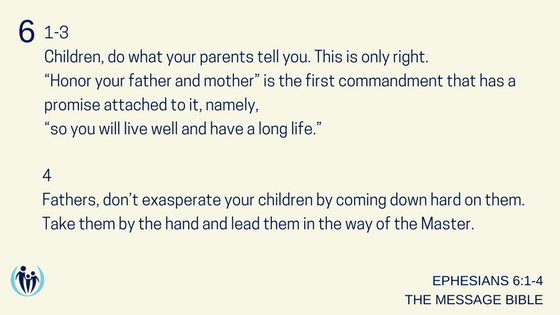
I learned to live out the full extent of my verse as described so beautifully in the Message, “Fathers, don’t exasperate your children by coming down hard on them. Take them by the hand and lead them in the way of the Master.”
So I modeled more intentionally. I encouraged more. I learned to nurture values and skills that empowered my kids to desire obedience because they valued God’s ways.
A legacy of grace, instead of demands
I’m so glad I made this shift. Today my kids’ memory of me is not as their dominator, but as their discipler—a loving and graceful daddy. Not perfect, but in Daniel’s words, I was “cosmically safe” (in the big picture of our relationship) to him, because I was faithful to reconcile with grace whenever I slipped back into a big, angry power reaction.
I encourage you to commit to obeying your verse first and foremost. You just might find your kids more naturally following their verse. But even if that takes a long time, you’ll have peace of mind knowing you’ve obeyed the Father who loves you and your kids deeply.
© 2017 Connected Families
Related Posts





How to Turn Fast, Large, & Loud into Slow, Low, & Listen Mini Course
None of us feel good about habitually yelling at our kids. Shifting our approach is hard and is the important foundation work needed to communicate, “You are SAFE with me.”
Invest just 10 minutes a day just four days with this mini-course that blends brain science, Biblical insight, and practical “slow, low, and listen” strategies for daily life. Your heart and mind can find a new path to connection with your kids.
