



My Child Says He Hates Himself: 3 Life-Giving Steps to Change the Shame Cycle

“I hate myself.” “I’m a bad kid.” “I wish I was never born.” Hearing those words from your child is like a gut punch. If your child says they hate themselves, don’t panic; instead, dig deeper. There are a lot of reasons a child might express self-hatred: depression, perfectionism, a desire to get your attention, or even an inability to express exactly what they’re feeling (and it feels bad!). If this has been true for one of your kids, it can feel so hopeless to do your best to lift your child out of their pit of self-hatred. It’s challenging when they vehemently resist your efforts to encourage or console them.
For Wendy’s son, it was a combination of perfectionism, explosions, and deep shame that led to these sorts of words. Kids who are explosive with yelling, aggression, or name-calling are frequently filled with shame after an emotional outburst. They may run off, cry, or say terrible things about themselves.
Many children have emotional outbursts because they are perfectionists and feel that they just don’t measure up. Research suggests that children raised by perfectionists may also develop perfectionist tendencies. To hear more about Lynne’s personal experience with this check out, “I Was a ‘Critical Parent’: 6 Steps I Took to Find a More Loving Way.”
My child says he hates himself: is he stuck in a deep shame cycle?
Wendy was desperate to find a solution for her son, because everything she tried seemed to make it worse. He would often say things like, “Go away! I’m a bad kid!!!”
Her story has many insightful ideas to encourage the heart of a really discouraged child…
My son Luke was an intense perfectionist—hard on himself and others. His big emotions would erupt in strong, hurtful, or colorful words. After such an explosion, Luke would be engulfed by a tsunami of remorse and shame. “I’m a bad kid! Nobody will ever like me. I’m going to hell because that’s where bad people go!” If I tried to console him by contradicting this terrible self-hatred, he would yell “Shut up!!” and run to his room.
Step 1: Identify the gift-gone-awry
If this story sounds familiar, you’re not alone. Shame and self-hatred are painful places to see your child, but there is hope. If your child is quick to identify their faults, it might be time to focus on identifying and pointing out their strengths. This is most effective right in the middle of their misbehavior. Wendy describes how she applied this approach below.
My efforts to confront and discipline were totally ineffective. I had read many parenting books, including numerous ones on strong-willed children. The ideas either didn’t resonate with the kind of parent I wanted to be, or didn’t help when I tried them. I felt desperate.
When I read Discipline That Connects With Your Child’s Heart, the concept that struck a chord was identifying my son’s “gift-gone-awry.” In the midst of his misbehavior, God’s image in him was coming out twisted by sin. I was skeptical of this new idea at first, but I prayed and dove in. I thought about Luke’s intense, colorful tirades and realized they were a reflection of his love for words, his curiosity about their meanings, and his extensive vocabulary. I was determined to get down on his level, as Jesus did for us, and call out that good gift when he struggled.
Step 2: Get down at your child’s level and empathize
At his next hurtful verbal explosion I set aside the old resentful recording in my head, “Here we go again…” Instead, I got down on my knees, looked deeply into his troubled eyes, and gently said, “Luke, you’re really angry right now. Your strong words come from the gift of a big vocabulary. I believe it’s a good gift God has given you. Let’s work together to figure out how to use that awesome vocabulary in a more honoring way.”
He didn’t expect to be treated with that kind of grace and love in such a very difficult moment. We were both in tears as we experienced God’s rich grace together. His discouraged heart soaked up this outpouring of love when he needed it most, and I thought, “Wow, this is safe. We’re gonna go through this differently than we’ve done it in the past.”

Step 3: Learn together
We all began to grow in an identity as a family of learners: “You’re so great at learning, and we’re all learning here together.” I helped Luke learn that when he is mad he can angrily and loudly say:
- “I’m so mad! I’m gonna go take a break.”
- “I have some really strong feelings that I don’t know what to do with.”
- “I just need some time to calm down.”
I was careful to model those kinds of statements myself, and sure enough, he began to use his words in wiser ways.
By giving Luke words he could feel good about using when angry, Wendy made it harder for Luke to feel ashamed of expressing anger. After all, feeling angry wasn’t the problem, but when Luke didn’t have the tools to express his anger appropriately, he was full of shame for his inappropriate expressions. If your child is feeling shame and self-hatred due to inappropriate behavior, is there a way you can give them the tools for more appropriate behavior?
Learning the power of truthful and life-giving words
We talked about how wonderful it is to use words to honor and build up. We learned and discussed 1 Thessalonians 5:11, “Therefore encourage one another and build each other up, just as in fact you are doing.”
Now, after tempers have escalated, I walk away feeling really good about the way I handled it, and he feels good about who God made him to be. Instead of “I’m a bad boy,” I am more likely to hear statements like:
- “This is really hard and I’m feeling nervous about it, but I’m gonna give it a shot.”
- “I had a strong feeling, but I showed self-control.”
- “Even if I make a mistake, I’m probably gonna learn something from it.”
- “I can try.”
- “I did my best.”
But where sin increased, grace increased all the more… Romans 5:20b
From hating himself to owning the gift of grace and giving it out
That first tear-filled breakthrough may have been one of the best moments ever. In other difficult moments I remember how that felt, and it draws me toward the same kind of response. I step back, pause, and think, “Even though right now I would rather yell to try to get compliance, how do I want to feel about this in 15 minutes? And how do I want my child to feel about it in 15 minutes?”
Recently we had a rough night, and I slipped into some old habits. As I tucked each kiddo into bed, I hugged them and told them I was sorry for being short-tempered and demanding. Luke’s reaction brought tears to my eyes. He sat up in his bed and hugged me so tight I could barely breathe. “You know what the best gift is, Mom? It’s grace. I forgive you.” What a change, from a boy predicting his future in hell to dispensing grace and forgiveness! We are all learning so much about grace.
It’s not perfect, and we’re still learning, but after all the searching and struggling, I have come home to peace-filled parenting: To truly love my children in their most vulnerable moments, to still see the good in them, and then guide them in how to use it well. This is parenting that resonates with your heart for your child and the kind of person you want to be!
Where is Luke now?
This story was written in 2014! A lot has changed since then, and Wendy shared how encouraged she is by how Luke has grown :
I never would have thought that we could come this far. Luke is now in high school and is thriving. He is very insightful and a thoughtful young man, and recently received an award for academics and leadership. Just like all of us, he sometimes needs a little coaching and encouragement to get back on track, but he is quick to pursue reconciliation after conflict. I love that and believe it will make him successful in life and relationships. But what is really amazing is his insight into others’ behaviors. He gently encourages and coaches others in the exact same things with which he used to struggle.
What an amazing gift to give a child: the gift of not having to be perfect. But even more so, the opportunity to practice the skill of repairing relationships and leaning into God’s grace.
If your child says they hate themselves, take a deep breath and…
Know there’s grace for you and your child. The greater our sin or struggle, the greater God’s grace. Self-hatred is often linked to a sense of being stuck in some bad behavior. Probably both you and the child know exactly what behavior (whether it’s explosion-like for Luke or something “quieter”). When your child has been stuck in a really difficult behavior, instead of simply continuing to correct, punish, or “talk them out of it,” maybe it is time for a whole different approach. Get down on your child’s level, identify a gift gone awry, and then learn together how to navigate intense emotions, staying rooted in God’s grace for all of you!
“But where sin increased, grace increased all the more…” Romans 5:20b
Note: Hear more from Wendy on these Connected Families podcasts :
© 2021, 2025 Connected Families
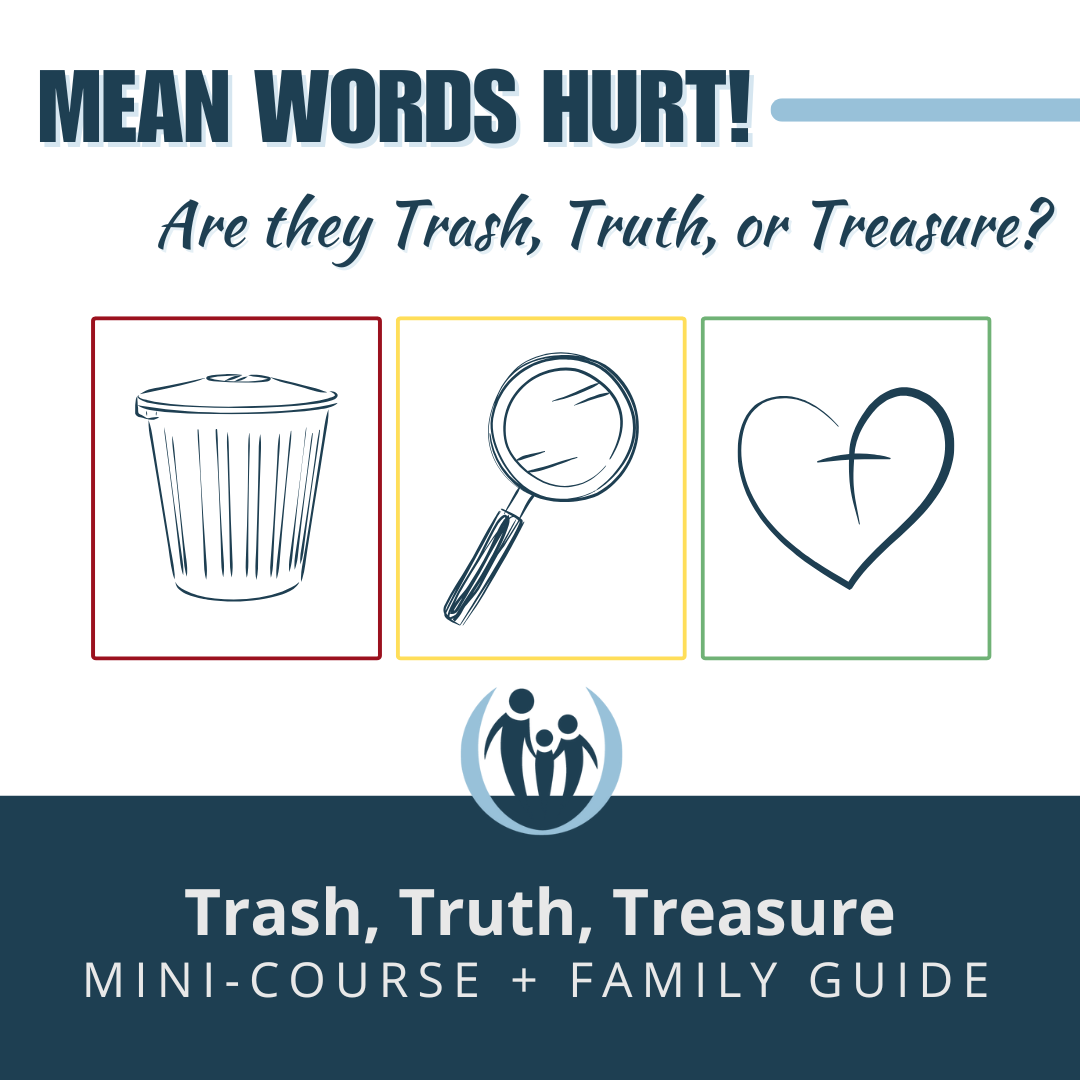
Transform hurtful words into life-changing lessons
When harsh words hurt your child, what do you say?
This mini-course gives you practical tools to turn these everyday moments into powerful opportunities for spiritual and relational growth. Your kids will learn to discard hurtful lies, discern helpful truth, and anchor themselves in God’s love when things get hard.
