



Help! My Child Is Defiant and Disrespectful
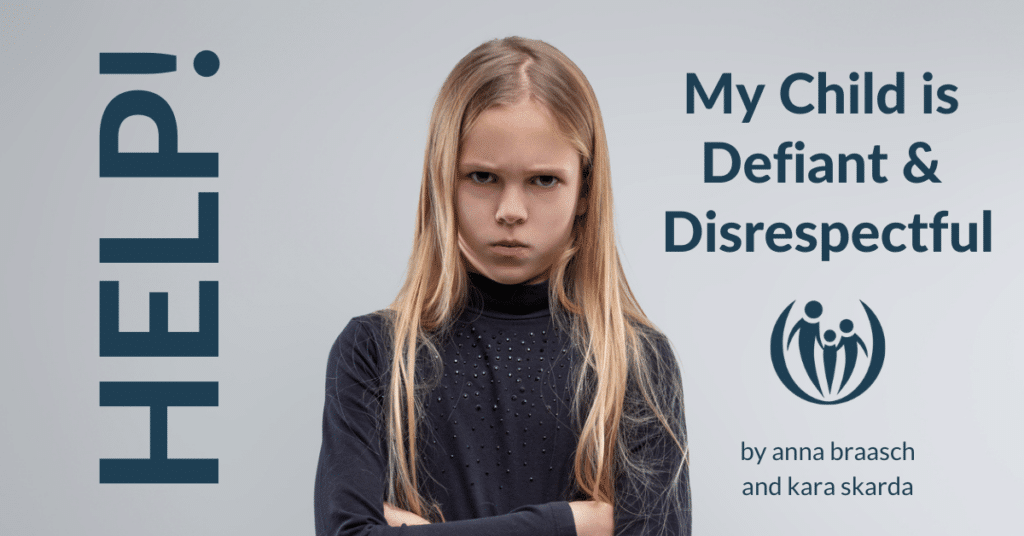
You probably know the signs of your child’s defiance or disrespect a few seconds before it lands. You see it in their body language, and you feel it in your own body as you try to prepare. If you’ve got a child who is frequently defiant and disrespectful, you’ve got some practice enduring intentionally painful words. It’s pretty tough to see the sunny side of things when your child screams irrational, hurtful things at you or blatantly defies your authority.
The easy way to react to a defiant or disrespectful child
To protect yourself and regain a sense of control, you might fire back, “This is NOT OKAY!!” “You can’t talk to me this way!” “Go to your room.” “No video games for you this week!” “I’m taking your phone away!” Or conversely, you might minimize their anger with a comment like, “I know you don’t mean that.”
If you’re like most parents, when you face disrespect, anger, rebellion, and general sassiness, you’ll probably either impose strong consequences or ignore it and hope the attitude goes away.
What’s going on under the surface…in you?
Unfortunately, neither of these approaches addresses the root of the issue. Defiance and disrespect do not happen in isolation; they are often symptoms of a lot brewing under the surface. Instead of quick defensive reactions, you can prayerfully consider a response that builds the kind of relational strength that will help heal the problem in the long run. That’s why we always encourage you to look below the surface.
The Connected Families Framework’s Foundation starts with the question, “What’s going on in me?” Ask yourself this and reflect on what you’re thinking and experiencing when your child shows moments of outright defiance or yells rude words at you. Sometimes, just naming what you’re feeling in those moments allows you to begin to calm your own reactions.
Other times, there may be a lie you’re believing about yourself (“I’m failing as a parent!”) or your child (“This kid just doesn’t care!”) that is holding you all back from the deeper, more respectful relationship you desire. Oftentimes, kids feel (and live up to!) our judgments.
If this kind of thinking is a struggle for you, consider this podcast about soaking in God’s grace so you can give it to your kids.
King David confidently asked God:
“Search me, God, and know my heart;
test me and know my anxious thoughts.
See if there is any offensive way in me,
and lead me in the way everlasting.”
Psalm 139:23,24
How could David be so vulnerable? He had been reveling in God’s intimate knowledge of and love for him for eighteen verses just prior to the request in verses 23-24. He felt safe enough to ask God to reveal his blind spots so he could better follow God’s leading.
When your child is loud, angry, and defiant, they are covering a world of inner hurt.
What’s going on in your child?
From there, dig deeper into what’s going on with the disrespect and defiance. These three questions may guide you:
- What is going on in my child during this stressful moment?
- Where might there be disconnection in my relationship with my child?
- Is it possible my judgments about my child are impacting my actions?
Why are kids sometimes disrespectful and defiant?
There’s not one single answer that applies to all kids, but it is almost always an outward expression of an inward struggle. When your child is loud, angry, and defiant, they are covering a world of inner hurt.
This doesn’t imply there is no sin involved for either of you in the conflict, but it is simply more complicated. (Consider the Lord’s compassionate response to Moses’ defiance or to Elijah’s “I’ve had enough, Lord.”)
A few possible causes of defiance and disrespect include:
- Your child is struggling with friends, school, or other things that have absolutely nothing to do with you, but you are the one safe person they feel they can show all their feelings to. They just haven’t learned a more constructive way of letting out negative feelings, so it comes out as anger and defiance at you.
- Their sensory system is overloaded or dysregulated, and they don’t even know what they’re upset about. You can easily recognize this in toddlers, but some kids struggle with it even into their teens. (You might be interested in reading about teaching self-regulation to your child.)
- They’re feeling disconnected from you (more on that below).
Why would my child feel disconnected from me?
In this broken world of ours, some of the causes of disconnect you can’t control, while others you do have more influence over. But since disconnect feeds anger, defiance, and disrespect, it’s good to understand. A few of the many potential causes of a disconnect in your parent-child relationship include:
- Sensory sensitivities/hyperactivity that make it difficult for children to receive physical touch and other calming comfort from parents.
- Stressful family circumstances in a child’s developmental years interfere with a parent’s ability to express caring and the child’s ability to receive it. This can be due to a number of factors such as adoption, illness, family disruption, and loss.
- A home environment that feels emotionally unsafe. This can cause children to self-protect instead of bond with a parent.
- A specific misunderstanding or painful event that has put some temporary stress on your relationship. Sometimes this even happens when you’ve done the right thing, such as laying down a necessary boundary, but your child was nevertheless hurt by it.
If your child feels disconnected from you, it’s especially important that the way you respond to defiance and disrespect is aimed at healing the relationship. Even if the disconnect isn’t the cause of the defiance (maybe they had a bad day at school, and they’re pouring the defiance and disrespect out on you precisely because they feel emotionally safe with you), focusing on healing the hurt while maintaining healthy boundaries*, is always wise.
*Maybe you need to take a step back, pause, and breathe in God’s presence before responding.
Get excited about the opportunity defiance and disrespect offer
Many years ago, when my children (who had joined our family through adoption) were around 4 and 6, some of the long-time parenting struggles we were experiencing started to escalate. During this time, I began to embrace the ideas that Connected Families taught, and I changed the way I parented and disciplined. The biggest change for me was to look for and even value the times when my kids were angry, disrespectful, rebellious, or sassy.
Why would I be excited about anger and disrespect?!
Because I knew that whenever disconnection and disrespect were present, it was the greatest opportunity to build connection and promote healing in our family. And that’s why I learned to look forward to my kids’ defiance.
The “Play-Doh” brain of defiance
To help me do this, I began to visualize their brains during high-stress situations as a big ball of Play-Doh. I could choose at that moment what kind of “print” in their Play-Doh brains I wanted to make. (This is an oversimplified analogy for neuroplasticity, but this word picture works for me!) These “Play-Doh moments” are when I have the most significant opportunity to rewire their brain pathways and heal their challenges with connection and attachment.
The Connected Families Framework during disrespect and defiance
To begin the healing process in our family, we became intentional in the messages
we were sending to our kids during discipline situations. We used the Connected Families Framework to work through these messages.
Foundation: You are SAFE with me, even if you’re screaming at me
The most important message that all kids (and especially children who struggle with attachment) need to hear is that they are safe. For me, this means lots of deep breaths and prayer. Even when “I hate you, you’re the worst mom ever!” is being screamed at me.
Connect: You are LOVED, even when you say you hate me
Secondly, my kids must know that they are loved no matter what. That my love for them doesn’t change based on how they treat me.
I learned from Empowered to Connect that: “Children from hard places need to learn how to trust in order to heal. For this to happen, parents must move in closer even as their child pushes them away. They must resolve conflict and respond to misbehavior in ways that both correct and connect. This often requires parents to connect first, then correct – an approach that goes against the instincts of most parents, but actually can make their correction even more effective.”
Coach: You are CALLED & CAPABLE of remaining calm during stressful situations
If my kids weren’t able to stay calm during stressful situations, that was a clear indicator to me that they needed more support in their development. This meant engaging professional help such as attachment therapy, play therapy, and occupational therapy (all the therapies!). My husband and I also modeled and practiced skills to coach our kids on healthy responses. Reading children’s books focused on character development was another fantastic way to develop these skills!
Correct: You are RESPONSIBLE for your actions
And, of course, as I was raising my kids, they still needed to be held responsible for their actions and misbehavior. My prayer life became essential as I became intentional about consequences that built reconciliation and long-term wisdom.
I was tucking my son into bed after a particularly rough evening when he was around 6, and I told him, “I love you.”
“Love you too, Mom.”
“You know what? I love you even when you say you hate me.”
“You know what, Mom? I love you too, even when I say I hate you.”
If your child is disrespectful and defiant, embrace the opportunity
Even now, as my kids are entering young adulthood, I try to visualize their Play-Doh brains and the messages that are being imprinted. As difficult as it might be, I choose to embrace times of defiance and disrespect, as these are the perfect opportunities to build safety and connection.
Author note: My children, 17 & 19, gave me permission to share this story. Through many big and small moments, we’ve grown to have a high level of mutual respect and admiration. Over the years, one factor contributing to this trust has been gaining their permission to share our story when we all agree it could help others.
© 2024 Connected Families

Give Connection this Year
