
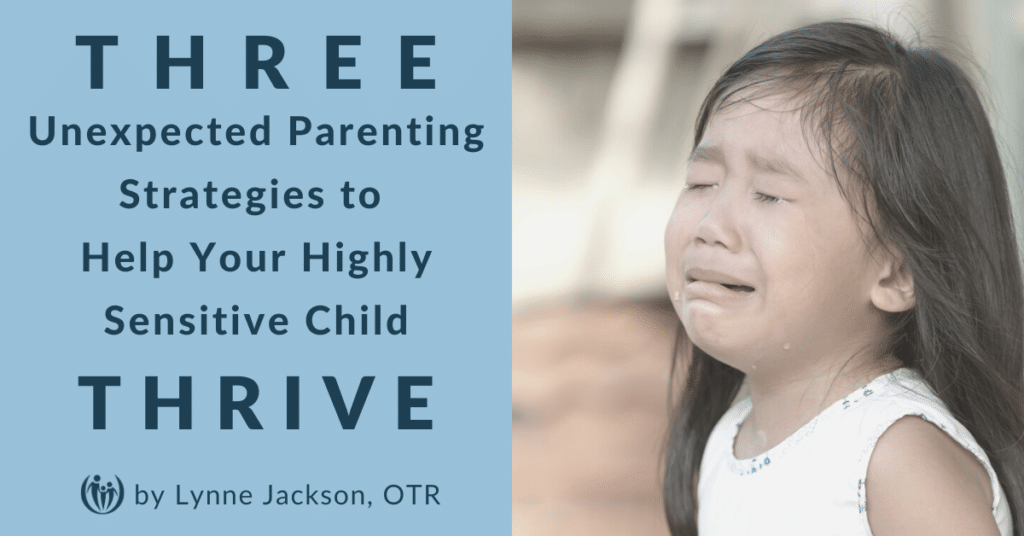
Do you have an “over-the-top” challenging child? Maybe you’ve already heard the term “highly sensitive” given to your child, either by teachers, a pediatrician, friends, or “Dr. Google.” Parents often see me for coaching because they are looking for parenting strategies for their highly sensitive child.
Or maybe you haven’t yet heard this term. Maybe you’re just wondering why this one child is so much more challenging than other kids their age. If so, it probably means that your child has high sensory or emotional sensitivity…or both! And along with sensitivity almost always comes higher anxiety and intensity. You might be seriously wondering, “How on earth do I parent my highly sensitive child?”
It’s important to distinguish and understand as best you can the differences between these two types of sensitivity (sensory or emotional) and how they may be an issue for your child.
Do you have a sensory sensitive child?
Kids with significant sensory challenges are easily overwhelmed by intense or confusing sensations from their body or their surroundings.
The specific behaviors that would clue a parent in to these sensory challenges are numerous and varied. These children are often louder, more intense, active, emotional, reactive, and/or strong-willed than their peers. (If you don’t have one of these kiddos in your family, you probably have a close friend or relative who does!)
You may relate to statements like:
- “Dressing is an ordeal for my daughter. No tags, and sometimes no socks because the seams drive her crazy. And then there’s toothbrushing and nail trimming!”
- “My teen has never been a touchy child. It used to be tough to get him to slow down for a hug, but now he even pulls away and acts like I’ve violated his space.”
- “Loud, unexpected sounds can just set her off. Fire drills are traumatic, just like blenders and vacuum cleaners when she was young.”
- “My child is such a picky eater. I feel like I’m always special order cooking. Anything green for dinner can trigger an outburst. And the smell and texture of foods can be just too much!”
- “My son just can’t sit still. He’s always squirming and wiggling. It’s almost impossible to get him to slow down, look me in the eye, and really listen.”
- “My child is easily overstimulated. Large groups of kids, crowded places, or busy stores are usually a setup for trouble.”
If these descriptions resonate with you, you will want to check out this 5-minute in-depth questionnaire. Note: The center column describes characteristics of a well-functioning sensory system and the two side columns list characteristics that cause stress for kids.
Sensitivity is not based on a certain number of items checked in the side columns. Instead, consider the degree those issues interfere with daily life. There might be a few things that are really stressful and limiting for your child. For example, your child can’t use a public restroom because the smells and flushing sounds are so aversive.
There is significant overlap between sensory processing challenges (including sensory sensitivity) and diagnoses like autism, anxiety disorder, and ADHD, but sensory processing challenges can be a stand-alone issue as well. Depending on how it’s measured, sensory sensitivities can present in anywhere from 5% to 16% (or even up to 21%!) of kids.
The latter study also called for increased services for those kids with both sensory sensitivities and an externalizing disorder. (An externalizing disorder is “problematic behavior related to poor impulse control.”) In families with both of these challenges, there is an “extremely high level of family impairment reported.”
If you are wondering if these sensory processing issues are contributing to your child’s challenges, ask your pediatrician about a referral to a pediatric occupational therapist.
The good news is that “warm and supportive parenting practices seem to suppress genetic risk for externalizing.” In other words, researchers have measured that effective parent training can be significantly helpful for the kids and families who struggle with these issues.
Wondering if your child has sensory challenges?
Review our Sensory Processing Questionnaire to have a better understanding of whether your child is sensory craving or sensory avoiding.
Do you have an emotionally sensitive child?
A close cousin of a sensitive sensory system is a sensitive temperament. A child that has a sensitive temperament usually has some sensory sensitivities as well, but the core characteristic is emotional sensitivity and depth.
This child may be observant and perceptive about others’ emotions and ask the kind of insightful, deep questions that make you want to consult a psychologist or theologian! They are often very perceptive in social situations and tune in to body language and facial expressions. They may quickly reflect someone else’s anxiety, especially a sibling’s or parent’s.
In general, children with sensitive temperaments are more prone to anxiety and perfectionism, and many are gifted kids.
Elaine Aron, a lead researcher in sensitive temperaments, suggests that around 15% of all children are considered “highly sensitive.” You can see a questionnaire she has developed about highly sensitive children here.
Our kids had both sensory and emotional sensitivity
Talking about highly sensitive children hits close to home for us: our two youngest kids had strong sensory sensitivities. Anxious outbursts could happen with the feeling of clothing changes, toothbrushing, or cold toilet seats. The sound of a blender, a vacuum cleaner, thunderstorms, or fire alarms inevitably led to intense, distressed reactions.
Our youngest son, a perpetual-motion kiddo, was described by his pediatrician as a “textbook example of ADHD.” Our daughter had a highly sensitive temperament and struggled with anxiety in addition to her sensory sensitivities.
What we didn’t realize was that although our oldest child didn’t have significant sensory issues (a few emerged as a young teen), he had an extremely sensitive temperament. As an adult, he is deeply concerned and grieved about the need for justice and compassion for everyone. But in the early years, that sensitivity and perfectionism mostly looked like being strong-willed, a deep thinker, and very determined about fairness.
The parenting strategy that didn’t work: disciplining a child for their sensitivity
We learned early on that disciplining our highly sensitive children for these reactions was like punishing them for getting a cold.
Needless to say, we had an “exciting” household! The various sensitivities and the intensity compelled us (particularly me!) to learn what we could do to help our kids, leading my career as an occupational therapist to shift to a focus on pediatrics. My years of working with kids with sensory and behavioral challenges and my husband Jim’s work with at-risk teens taught us a lot about the needs of sensitive, intense kids.
Parenting strategy #1: Set aside judgments and unhelpful thoughts.
The journey to helping your child starts with setting aside judgments or unhelpful, negative thoughts like “Here we go again,” “I’m so sick of this!” or even “What’s going to happen to this child?!” Instead, you can respond with God’s grace, realizing that your child’s challenging behavior is about much more than simple defiance, a “bad attitude,” or disobedience.
Of course, this is more than a parenting strategy: it’s about you and your internal thoughts and heart work.
If you have a sensitive, intense child, probably their physical sensations and/or their deep, strong emotions and thoughts are overwhelming, stressful, and even anxiety-producing for them! And their behavior often reflects this. (You’re probably not at your best when you are overwhelmed, stressed, and anxious either!)
When life overwhelms sensitive kids, they can be prone to what seem to be big overreactions, loud words, or “misbehavior.” In truth, it’s really about off-loading stress, and maybe even finding a big, expressive way to let you know they are stressed. Fun fact: swearing increases pain tolerance (which would indicate that “suffering in silence” is indeed a lot harder to bear.)😉
Not only do the loud words off-load a child’s stress, but they probably get your attention and engagement! And that’s what your child’s brain is driving them to do. Another fun fact: in stressful situations, our brains give off oxytocin (the bonding chemical) to drive us to get help.
With these insights, it can be easier to have compassion for your sensitive, intense child’s challenging behavior and let go of your judgments. Although loud reactions can be tough on a family, there is help and hope for you and your child.
Parenting strategy #2: Shift your focus from what to do, to understanding what’s going on in your child.
The first practical step if you’re the parent of such a child is to spend a little more time understanding “What’s going on in my child?” instead of “What should I do?” By learning more about your child’s nervous system, you can get strong clues about what might be causing the specific challenges.
So consider: “What’s it like to be my child?”
- What was happening just before my child really started to struggle?
- What was the environment like? What sensory system might have been overwhelmed? Was it chaotic, visually overwhelming, loud, confusing, too many people?
- Given my child’s wiring, was their skill level a mismatch for the demands of the situation (for example, required to sit still for too long a time)?
- How might fatigue or hunger have been an issue? (For example, after school can be a predictably difficult time for a sensitive child.)
- Did my child have reason to be anxious? Anger feels safer than anxiety, so it can be a quick default reaction for an anxious child (or parent.)
- Did my child experience failure or rejection? Is it likely they were discouraged, ashamed or had hurt feelings?
- Simply ask your child, “Is there something that made this situation harder for you than usual?”
One mom’s “Aha!” moment
I coached a mom whose desperation about “What should I do?” led her to seek help through coaching. First, we addressed the more helpful question, “What’s going on in my child?” As the mom began to understand her daughter’s nervous system and the constant state of “fight-or-flight” her daughter lived in, the mom had an “Aha!” moment.
“Could it be that my daughter’s constipation and crabbiness are affected by her sensory challenges?” I explained that stress can often throw off digestive function. The mom completed her flash of insight: “And the way we’ve been handling it has only added to her stress!”
This understanding changed the mom’s response to the situation in subtle but powerful ways. Her daughter’s condition improved dramatically.
Parenting strategy #3: Show empathy to your highly sensitive child.
When you better understand what’s going on in your child’s nervous system, you can better empathize. When you empathize, you are calmer, your child becomes calmer, and you can more creatively and positively develop solutions.
So practically, what does this look like?
Objectively describe what your child might have been experiencing:
- “It was really noisy in here, and then someone bumped into you!”
- “You were working so hard on that picture, and it didn’t turn out like you expected.”
- “When we didn’t have your favorite cereal, that was an unhappy surprise.”
You might even want to empathize with their experience:
- “The noise was stressful for me, too.”
- “I get frustrated when things don’t go as I expect.”
- “I understand being disappointed about cereal – I’m sad when I’m out of coffee in the morning!”
You can also validate what’s important to your child:
- “You have more fun when you play with just a couple of kids.”
- “You really like to do a good job on your pictures.”
- “You love that Cinnamon Toast Crunch! It’s your favorite!”
When we respond to our kids with empathy, it represents the empathy of Jesus:
For we do not have a high priest who is unable to empathize with our weaknesses, but we have one who has been tempted in every way, just as we are—yet he did not sin. Let us then approach God’s throne of grace with confidence, so that we may receive mercy and find grace to help us in our time of need. Hebrews 4:15, 16.
Jesus understands us and, because of this, He can help us. And when you empathize with your sensitive, intense child, they know this: You get them, and you can help them.
Parenting strategies that aren’t really “strategies”
Of course, you might have noticed that these so-called “parenting strategies” for parenting a highly sensitive child aren’t… well, much of strategies, per se. They are, for the most part, the way you position your heart and thoughts. And that’s vitally important. Sensitive kids can be pretty perceptive. Many parenting “tips and tools” run amuck because parents use these strategies with frustration and a need for control, and kids smell that out.
Our children’s insightfulness is actually a gift to us. It holds us accountable to bring our overwhelmed hearts to God for encouragement before we engage with them.
Even empathy isn’t really empathy if used as a strategy or as a means to an end. Sometimes parents have told us, “I tried empathy, and it didn’t work!” If children sense that your “empathy” (“Oh, you seem really frustrated”) is just to get a behavioral outcome from them, you’ll probably erode your influence and their trust in you.
However, when you are positioned in a non-judgmental, empathic stance toward your child, your child begins to feel loved and understood. Their fight/flight system senses you’re an ally in the threat that is triggering them. That helps them to calm down. Just like us when we truly believe, “If God is for us, who can be against us?” Romans 8:31
Finally, you can gradually transition to solution questions, like:
- “Do you need a hug?”
- “What does your body need right now to feel better?”
- “What shall we do to solve this problem?”
This way of responding communicates the four key messages of the Connected Families Framework:
- You are SAFE with me.
- You are LOVED no matter what.
- You are CALLED and CAPABLE of solving problems with others.
- You are RESPONSIBLE for making right what you’ve made wrong.
These messages, along with the many sensory-based resources we have for sensitive kids, can get your child started on using that awesome sensitivity and intensity for God’s wonderful purposes to be a blessing in this world!
Holding on to hope in God’s purposes for your child
Knowing that your child may be more sensitive than most can help you hold on to hope as you guide your child toward the wonderful purposes God has for all that sensitivity and intensity. I’ve often wondered what it would have been like to be the parent of a strong-willed Apostle Paul or impulsive, sassy Peter when they were kids! Did their parents have any idea of their incredible potential in the Kingdom of God??
A story of hope: Two of my first coaching clients, Ted and Jill, had a really sensory-sensitive 5-year-old who could be described as intense, impulsive, and sassy! Their daughter Lucy would have screaming outbursts about how her car seat felt unless her mom put a soft towel in it. And she was about as strong-willed as a kiddo could get. She would have been happy to run the family! Her dad told me he calmed himself when responding to her with the thought, “God made you!”
Want more of Ted and Jill’s story? Check out this podcast, “Strengths and Weaknesses: What a Child’s Misbehavior Tells Us”
Ted and Jill worked hard to parent according to the Connected Families Framework, giving Lucy lots of thoughtful choices to meet her valid need for healthy autonomy.
I was invited to Lucy’s graduation party and together we celebrated how God made her! All that intensity had been used at her very large high school to joyfully share the gospel, start a bible study, be elected Homecoming Queen, and give a crazy-amazing commencement speech as valedictorian!
Now can you take it to the bank that if you “do the right stuff,” your child will turn out just like that? Of course not! But we want to encourage you not to paint a dismal picture of your child’s future because they are struggling now. There are many practical strategies for helping highly sensitive children thrive!
And so you too can calm yourself with scriptural truth when your child is struggling: “God made you. And He has good purposes for your sensitivity and intensity!” Together with your child you can discover those purposes.
I praise you because I am fearfully and wonderfully made;
your works are wonderful,
I know that full well.