



Why Do Siblings Fight So Much? The Good News and the Bad News
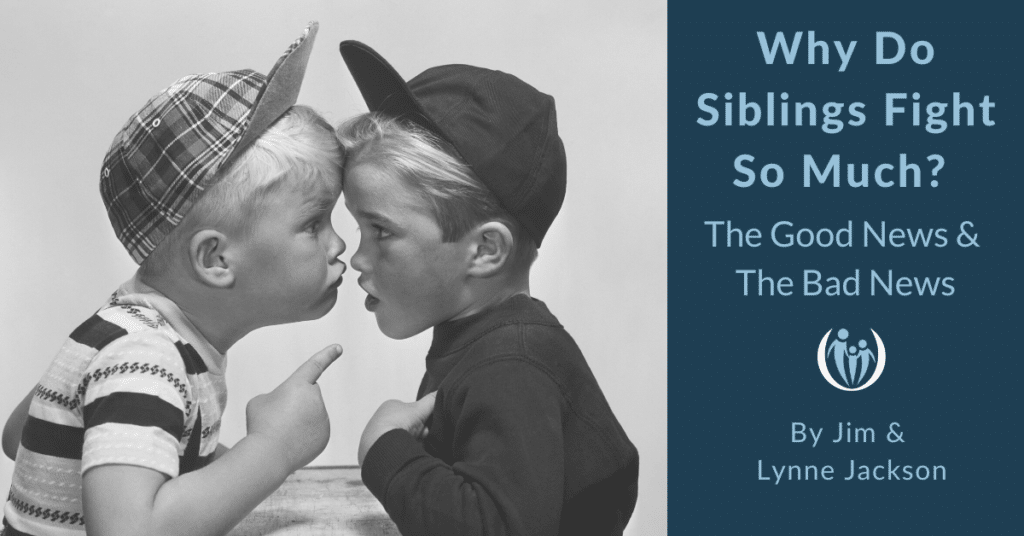
“He hit me!!!” “She took my marker!” Seriously, don’t you wonder, “Why do my kids fight so much???” Why siblings fight has been a question plaguing parents for millennia…
I know I’ve thought, “I am just refereeing 24/7, and I certainly have better things to do with my day. This is not okay! The fighting needs to stop.”
Unfortunately, the more we have an expectation that our children shouldn’t fight, the harder it is to be prepared for the challenge of conflict.
The bad news first: Your kids really do fight all the time
Research by University of Illinois professor and family researcher Laurie Kramer, Ph.D., revealed that siblings between 3 and 7 years old engage in some kind of conflict an average of 3.5 times an hour. The youngest kids (those in the 2 to 4 age group) are the most conflict-prone at 6.3 conflicts per hour–or more than one clash every 10 minutes.
It’s also rather startling to think that the first siblings in God’s creation had such conflict that their relationship ended in murder!
Sorry, but your kids aren’t going to stop fighting anytime soon. In fact, you can expect that they will have many conflicts.
Why siblings fight
Maybe why kids fight is the wrong question. After all, why do we think they wouldn’t fight?
Even as redeemed people, we still carry around the baggage of sin. “I do not do the good I want to do, but the evil I do not want to do—this I keep on doing…” Romans 7:19-21. And this shows up frequently in our relationships with each other. With that in mind, conflict is a normal and even healthy part of adult life. It’s how we get through it that matters.
Children experience the same frustrations and conflicts that adults experience but with much less skill (and frontal lobe development). They have neither the life experience nor the cognitive abilities to resolve disputes well. If they fight, they are not bad kids. (And you are not a bad parent!)
We are all “beloved messes” – works in progress needing God’s grace. It’s helpful to adjust our expectations to fit our kids’ abilities and embrace the fact that conflict is quite normal. Suppose you’ve been viewing conflict as an unnecessary and irritating interruption. What would it take to start seeing conflict (and training kids to resolve it) as an integral part of family life? This article sheds more light on how to do this and how our past experiences in our family of origin may influence how we view conflict.
We have a podcast on this topic!
Check out Episode 139 or our podcast, “How To Help Siblings Stop Fighting All the Time” and feel equipped and encouraged!
The good news: All that fighting is a great opportunity!
How would things be different in your family if you viewed conflict as the perfect opportunity to build essential relational skills for your kids’ future?
- Unlike friends who squabble, siblings can’t retreat to separate houses when they fight. You are shaping your child’s future relationships by helping them gain essential skills to solve and negotiate conflicts. What a great gift to them (and your future son- or daughter-in-law!).
- You are also equipping them for success at school. Research shows that “kids who practiced the best conflict-resolution skills at home carried those abilities into the classroom.”
- Adult life is all about peer relationships. Learning to solve conflicts can prepare kids to be effective team members at work or church. When siblings make peace after a brawl by gently tossing a pillow as they go to bed, they are learning the skills to someday playfully encourage a cranky co-worker or thaw the ice in a tense church committee meeting with a light-hearted comment.
- An added benefit we’ve seen in our work with families is that siblings who battle more as children tend to be closer when they’re adults than siblings who avoided each other. They may even find themselves affectionately reminiscing about their crazy arguments as kids.
With this in mind, stop legislating solutions to the conflict, which trains children to depend on you. Facilitate their learning to resolve conflict themselves so that you eventually work yourself out of your referee job! Lean into the Holy Spirit’s guidance in those challenging moments with your children.
The question is not whether your kids will have conflict (they will). The question is, what are you going to teach your kids about how to handle it? Will it be rooted in God’s grace and truth for all and a belief in your kids’ ability to learn to resolve conflict? If so, you’re well on your way to watching them grow toward grace-filled, connected relationships throughout their lives. Jesus stressed the value of this on His last night with His disciples.
“A new command I give you: Love one another. As I have loved you, so you must love one another.” John 13:34
Related Posts