

Why Punching a Pillow When Angry Doesn’t Really Help Your Child
and what DOES help
Have you ever directed an angry child to punch a pillow? Hoping that would provide some cathartic release for their frustration? Or maybe just selfishly wanting them to be done with an annoying outburst?
Some parents have been encouraged to buy their angry kids punching bags, hoping it will help. But telling a child to punch something when angry can communicate, “I don’t care what you’re upset about,” and it usually backfires.
There’s a good reason why.
Punching a pillow or yelling to let off steam does nothing to resolve the original problem. It gets a child all worked up, adrenaline flowing, with no actual resolution to their anger. After the punching and yelling are done, the problem is still there.
What punching a pillow (or punching bag) when angry actually teaches
I (Lynne) recall the time during some intense parenting frustration when I went out into the garage and screamed. I even kicked the tires of the car. I was hoping to subdue my intense anger at my kids. It did NOT release my tension. Instead, a sore throat, stubbed toe, and feelings of foolishness only added to my angst.
Aimlessly hitting a pillow, punching bag, or some other inanimate object teaches your child to vent his anger at something neutral. Doing this does nothing to validate his feelings or solve the problem. It does not build wisdom. Instead, this usually teaches kids to be passive-aggressive with their anger.
What does research show about aimlessly hitting things when angry?
Research shows that punching something when angry reinforces the link between being angry and acting aggressively. It communicates the message, “Harming something will help you feel more in control.”
There is a better message to convey: “Figure out what you’re feeling, and take responsibility for that. You’ll feel more in control and can constructively resolve your anger.”
Keep reading for specific suggestions on how to teach this.
What the Bible says about anger
This idea dovetails nicely with Ephesians 4:25-27:
Therefore each of you must put off falsehood and speak truthfully to your neighbor, for we are all members of one body. “In your anger, do not sin”: Do not let the sun go down while you are still angry, and do not give the devil a foothold.
This verse has some key principles:
- Anger is not a sin.
- It should be dealt with as soon as your heart and mind are rational.
- Truth is vital. This builds a sense of connection and respect for the person you are angry with (verse 25) and does not allow the devil to gain a foothold (verse 27).
With all that in mind, let’s consider how to help angry kids!
Therefore each of you must put off falsehood and speak truthfully to your neighbor, for we are all members of one body. “In your anger, do not sin”: Do not let the sun go down while you are still angry, and do not give the devil a foothold.
Ephesians 4:25-27
Help kids figure out how to release big anger constructively
Want to better equip your kids to express their anger? Help them learn new skills for constructively expressing that anger.
Here are four ideas to help kids express anger without aimlessly pummeling something:
- Model identifying and problem-solving complicated feelings yourself. “I’m so mad! I don’t know how to solve this problem, so I’m going to take some time to think about it.” Model taking a deep breath and counting to 10.
- Suggest physical movement that has a constructive end goal. “Let’s play a little catch, and then we can talk about this issue.”
- Go for a run with your child.
- Ride bikes.
- Jump on the trampoline, or bounce on an exercise ball.
- Practice kickboxing or a martial art. (Note: It’s purposeful movement, not aggression, as long as your child practices when they’re not angry too.)
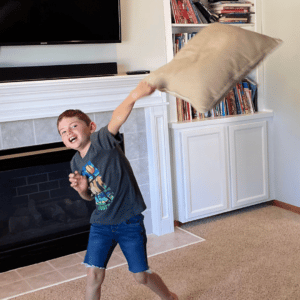
- And here’s where a pillow might come in handy (if your child is frustrated but not in a full-blown rage). A silly, connective physical activity can be tossing a pillow at your child to try to punch in mid-air. “You’ve got some big energy! Let’s see if you can launch this to the moon!” Because the pillow is in mid-air, it often flies off in a random (sometimes humorous) direction and does not get an angry pummeling. Repeat a few times as needed. Kids usually love it. This activity has helped numerous parents we have coached pave the way for a conversation about a child’s real frustrations.
- Ask kids questions that help them identify feelings. “You seem upset. Tell me more about that.”
- If they can’t figure it out, offer some choices:
- “Do you feel more angry or hurt by what just happened?”
- “What would you like to do about how you’re feeling?”
- “How could we handle this in a way everyone feels good about?”
- If kids are really struggling with figuring out how to speak the truth in love, this blog post can help.
Physical movement with a purpose (other than aggression) helps calm a nervous system that is in a “fight-or-flight” response.
If you’ve got an intense, sensitive child
Some kids can’t process their feelings until their body calms down. Physical movement with a purpose (other than aggression) helps calm a nervous system that is in a “fight-or-flight” response.
Or, as they say, “Motion changes emotion.”
One mom found a solution for her intense daughter, who was beginning to show aggressive tendencies when angry. She would invite her daughter to go on a run. While running, they would talk about the problem. First, they would identify feelings. Then it was easier to problem-solve them.
Much better problem-solving and thinking occurred than if she’d just told her daughter to punch a pillow! Like this mom, look for purposeful movement for your child that will help put your child in a calmer state of mind. This equips them to be more ready for problem-solving.
As you and your child better learn how to navigate anger constructively, you are equipping them with skills to last a lifetime!
You can help your child with their anger.
Learn how to break the addictive anger cycle. Get the FREE ebook, Helping Kids With Anger.