


How God Created Us for Community…and Science Agrees!
The human need for connection is God-ordained.

Have you ever worried that your relationship with your child is at risk? Is there a growing disconnection between you and your kids? Do you wonder if your firm discipline might be disenfranchising your kids? Or perhaps you’re wondering if it’s possible to be your child’s parent and friend at the same time? God created us for community and connection, and the integration of science and the Bible only proves this!
In the 1990s, as professionals working with children, youth, and families, Lynne and I began noticing how increasingly relationally disconnected kids and parents were despite parents’ good intentions. We saw how disconnection fueled resentment, rebellion, and discord in relationships in homes, extended family, and the community. We saw the price society was paying for what seemed to be a growing epidemic of disconnection.
This intensified our desire and belief in the importance of fighting for connection even when life was hard and disagreement strong. As Lynne and I began teaching other parents things we’d learned firsthand in our own family and through working with others, we discovered that there was a beautiful harmony between scripture and science regarding connection and community.
The reality is this: God created us for community. The longer we work with parents, the more we see that science only confirms what the Bible has been teaching us all along. What follows is a whirlwind tour of how the idea of connection – the knowing, loving, and enjoying of other people, especially our children, became the centerpiece of Connected Families.
Connection: science and God agree.
God created us for community, and it turns out there is science behind the human need for connection. In fact, it has been shown that relational connection is the best predictor of a positive future and the most significant antidote to many of the social challenges of our day. When people are disconnected, they really do “look for love in all the wrong places,” or they may even quit looking for connection altogether. When well-connected, people tend to make better choices for themselves and the world.
When science is so clear about something, it’s no surprise to the God who created science! That’s why He built families (or, more precisely, clans) for the care of people. Typically, although not always, the people who know and love us the most are family. And the Bible is clear that when “parents’ hearts are turned to their children”, those children are best prepared to live how God intended. (Luke 1:17)
Note: As Christians, the goal of connection is to set an example of God’s unconditional love. This is not to say we excuse our kids’ sin, but that we stay connected as we address it. We write more about this here.
To connect is to know, love, and enjoy another person. The deeper the knowing, loving, and enjoying, the stronger the connection. Learning to connect well with each of your children may be the most important parenting skill you can develop.
How I learned about the human need for connection
One of the first church songs I still remember from my childhood was during the annual youth choir concert. I don’t remember the other songs, but one stood out. I still remember where I was sitting when Pastor Brown turned toward the audience and sang this connection song:
Turn the hearts of the children to their parents.
Turn the hearts of the parents to their young.
Turn the hearts of us all to one another.
Turn the hearts of the people to the Lord.
I looked forward to joining that choir. As a teen, I became an informal “connection scientist.” My mom ran a daycare in our home, and I especially enjoyed the challenging kids—you know, the ones who were too loud at nap time, too wild on the play equipment, or too rough with other kids. When we found ways to have fun together, these more difficult kids became more responsive to my efforts to encourage them to be quieter, calmer, and more respectful of others.
That’s where science came in.
Observe well. Test ideas. Try this. Try that. Not too much. Not too little. If it doesn’t work, try something else. If it works, do it more. Build on what you learn.
My love of connection continued through high school and college as I volunteered in care facilities, tutored inner-city kids, built relationships with neighbors and classmates, and generally connected with people wherever I went. Some people were quick and natural to connect with. Others took more time and effort. Some (either because of me or because of them) would have no part in connecting.
Human connection became my career
I wasn’t exactly sure what I wanted to do when I grew up. I’d been to the Philippines after college on a ten-month ministry project and returned shortly after the youth pastor at my church unexpectedly resigned. I was asked to fill in until they could find a properly credentialed candidate. I was hesitant because I’d had no substantive experience working with youth. But, the senior pastor gave me permission to keep it simple and connect creatively with the kids who showed up for the youth group.
I started observing and trying ideas. If something didn’t work, I tried something else. If it did work, I did it more. That summer, we had a lot of Ultimate Frisbee Bible studies. I taught a lot of kids to fish and waterski. I opened the Bible whenever it seemed natural. I kept building on what I learned. I got to know them. I enjoyed them. How could I not love them?
The youth group grew over the summer, a rarity in this church’s recent history. At the end of the summer, the senior pastor and the chair of the board approached me with the offer:
“Jim, we’d like you to consider the role of full-time youth pastor.”
I resisted. I didn’t have a seminary degree. No previous church ministry experience. None of the main things they were looking for on the job posting. I reminded them of the qualifications they sought.
“That’s all stuff you can get,” added Pastor Dave. “But the thing that matters most, that you can’t teach, you have it. You love the kids. It’s obvious. And they love you. The rest of that stuff…I’ll help you.” I got hired because of my ability to connect. And it’s what I’ve done ever since.
Connection is the gateway to another person’s heart
The bottom line is that people thrive when connection is strong and suffer when connection is weak. I love connecting with people and teaching people to connect with each other, especially parents and their kids. Connecting the hearts of parents and kids was even how God prepared the world for Jesus!
“And he [John the Baptist] will… turn the hearts of the parents to their children and the disobedient to the wisdom of the righteous—to make ready a people prepared for the Lord.”
Luke 1:17
When it comes to the importance of connection, science tells us what the Bible has already made clear: there is no more significant relationship than that between parents and their children. And God created us for connection and community.
The most important message to send your kids
We often ask parents, “What is the most important message, beginning with the words ‘You are…’ that you want your kids to embrace as their identity?” Nearly unanimously, the first answer they give is, “You are loved!” It is almost as if this need for love and connection is hardwired, which, indeed, social scientists say it is.
On the one hand, making sure kids know they are loved as a top priority may seem simple. Imagine if every time there was stress or sin of any kind, the first thing a child experienced was a loving touch, loving words, and loving actions. The world and its children would be so much better off. Connected kids do better in life by just about all measures.
However, conflict of all kinds often tends to get the upper hand. We forget about connecting and get right into the business of teaching or correcting our kids. Teaching and correcting are important. But if done at the expense of connection, it leads to, well, disconnection. And disconnection leads to challenges of many kinds. Crime, addiction, mental illness, violence, and life expectancy all become more problematic where disconnection abides.
When asked how well they connect with their kids, most parents say, “I think I connect pretty well with them.” Their intentions are good. But what do you think the kids would say if asked to gauge their parent’s connection with them?
How can I better meet the human need for connection with my kids?
Much has been written about how to connect better. What I’ve discovered is that rather than teaching people to connect in ways that feel unnatural to them (and thus their kids), the best starting place is to identify what you are already doing to connect successfully.
For some, it’s encouraging notes. For others, it’s hugs. Some share common interests. Whatever you do to connect with your kids in some small way – do it more! You already know how to do that, and it won’t be awkward.
The hard part is to be intentional. For example, if you already connect with your kids by watching cartoons on Saturday morning, make a special date to do it on Wednesday afternoon. If it’s cooking a meal together once a week, do it twice! If it’s when you tuck your kids into bed at night, tuck them out in the morning. If you’re good about empathizing with your child when she gets injured, put that same empathy into her poor grades when she is struggling.
One of the best ways to know how (or if) you’re connecting well with a child is to ask your kids questions like, “What makes you feel the most connected to me?” Based on the answer, ask, “What could we do to be better connected?” Then do it! 😊
We asked our kids one day, “What do we do that makes you feel the most loved?” Their answers surprised us and were significantly different from each other. Try asking your kids questions about how they view the connection in your relationship – you might also be surprised…
Other quick ideas for connecting:
1. When your kids are present, be present.
This doesn’t just mean being in the same room together; it means letting them know you are there for them. Do this by noticing details about them and verbalizing them. Perhaps something like this: “I noticed you concentrating. I could tell by the way you were________________.”
Paying attention to little details helps a child feel valued and seen.
Paying attention to little details like this helps a child feel valued and seen.
If the child says something outrageous, let the child know you’re listening by giving full focus to their statement, repeating what you heard (not judging or giving your opinion), and asking for more. Maybe like this, “So you hate your math class. What do you hate about it?”
This can be so hard! I know from experience that the first impulse when kids say extreme things is to say something like, “You shouldn’t hate it.” or “I don’t think the teacher cares whether you like it or not.” We say these things because we want to toughen our kids and prepare them for sour experiences. But more often than not, these statements lead to less connection, not more.
When kids feel heard, they are far more likely to be open to constructive (wisdom-building) questions later.
Whether it’s ice cream, board games, concerts, sporting events, or adventures of some kind, when people have shared experiences, it draws them closer.
Note: It’s important to remember that the goal of shared experiences is connection. (Not to drag your child to your favorite activity, or to manipulate, get obedience, or a specific desired behavior.)
3. Create connection routines.
Some families do weekly game nights, and some have special greetings or affectionate nicknames. Research shows that sharing food together builds connection and leads to far better outcomes for children.
4. Lots of hugs! (Or high-fives!)
And, of course, don’t forget the importance of physical affection as you build these routines. The least stressed 30-year-olds in the world are those who received lots of physical affection as children.
5. Jim’s favorite!
My favorite connection activity was to surprise my kids with something goofy and unexpected. Perhaps I’d go in and beat their alarm clock by a minute by singing (even dancing) a gentle wake-up tune. Or interrupt their chore time with a Nerf-gun war. In their older years, we’d show up at their college dorms with surprise care packages. Once, we even “delivered ourselves” in a refrigerator box by ringing the doorbell and then hiding in the box (with a plate of cookies)—anything I could do to keep laughter present through all the ups and downs of everyday life.
Can I connect and still be “The Parent”?
Much has been said about how you should not be your child’s friend. I get it. God gave parents the role of parent for a reason. That said, it’s clear that being in a parental role doesn’t necessarily mean you always have to be the strong-handed authority.
When the apostle Paul described his relationship with his spiritual “children” at Thessalonica, he described wearing many “hats” in his role. He was gentle and humble (like a child), nurturing and caring (like a mother), affectionate and open (like a good friend), and encouraging (like a father).
Research has also shown that it’s best for kids when parents can flex to a child’s needs and take different roles or “wear many different hats.” So yes! Be the parent—if “parent” means setting and keeping limits. But if that’s all you do, or if there is an imbalance of too much strong authoritarian parenting and not enough warm, supportive connection, it can lead to avoidance of God and authority figures.
But what about when kids require discipline?
No question. Kids will require discipline. However, discipline does not eradicate the need for connection. In fact, some of the most effective discipline stories we’ve heard incorporate connection. Like the time Jesus connected with an adulterous Samaritan woman at the well, had a gentle conversation about her life, and offered her the water of eternal life. (John 4)
A practical story of connecting during discipline
We know of one father, John, who got down on the Lego-cluttered floor with his eight-year-old son Andrew. Andrew habitually left a Lego mess in spite of typical discipline measures.
Instead of another stern lecture about “Why you need to learn to clean up after yourself!” and discipline by taking more Legos away, John sat in the middle of the mess alongside Andrew. Surveying the room from his new vantage point, he sighed and empathized, “Oh, it really feels overwhelming down here. Is that how you feel?”
“Yes!” cried Andrew, now feeling understood about this for the first time.
Keep in mind that when kids feel lectured or threatened, their “fight or flight” brain goes into gear. They quit thinking about rational things and start thinking and impulsively acting to protect themselves. They are defensive. Perhaps even combative. But when kids feel understood, their frontal lobe – the thinking part of their brain – is much more active and receptive to learning.
With Andrew calmer and more receptive, John’s “connection in correction” effort continued. “I have an idea,” John calmly offered, “How about you sit on the bed and tell me where things go, and I will put them away because I’m sure you know where everything goes.” Andrew eagerly jumped on his bed and gave instructions to his dad. John had fun putting the things away and then said, “Wow! You know where everything goes! So next time I ask you to clean up, do you think you’ll need help, or do you think you’ll be able to do it alone?”
“Maybe a little help?” Andrew replied.
A few weeks later, Andrew had become responsible for cleaning up his Legos even without being asked. Legos strewn all over the floor were never an issue again.
Andrew learned an important piece of the Connected Families Framework: that he is called, capable, and responsible. He and his dad had a connection (through discipline!) about his Legos, and they grew closer through it.
(You can learn more about these concepts in Discipline That Connects With Your Child’s Heart.)
But what about when kids are really nasty or aggressive?
The first step as a parent is to self-regulate and get calm so you don’t match their angry intensity. Your anger will only feed their intensity. You can even repeat this scripture in your head.
“God’s kindness is intended to lead you to repentance.”
Romans 2:4
What happens when you let go of the primary goal to achieve a quick change in behavior? And instead, focus on becoming a conduit for God’s kindness?
FBI negotiators know that their best chance for good outcomes (behavior change) in a hostage situation is to listen, empathize, and build rapport with the perpetrator. In short? Connect. To do this requires a heart of compassion, knowing that “hurting people often hurt people.” Making demands on perpetrators will often inflict more hurt. So, if FBI negotiators do this when lives are at stake, why not try to connect when our kids are feeling overly aggressive and nasty?
De-escalating challenging situations
In my work with high-risk teens, we knew that connecting was the best way to de-escalate in the toughest situations. Only in rare instances, when safety was threatened, did we do what was immediately needed to protect youth from harm.
Even when I stepped between two teens about to kick or hit each other, my next move was to empathize using language they could relate to, “This sucks!” I’d say as loud as needed. “You two are really pissed!” I did what I could to join them rather than oppose them.
I would repeat whatever they said so they knew I was listening. Then I’d ask, “What am I missing?” Not in an angry tone but in a respectful (though still loud) tone. Usually, one of them would add more. I’d ask again, “What else?” (This is one of the best questions when seeking to truly understand. It keeps the conversation open. If instead you say, “Anything else?” it tends to close the conversation.) Every time I did this, the teens settled down. Some talked it through with each other on the spot, and some decided to wait.
Connecting with really upset kids almost always bears immediate fruit. If not, keep connecting and watching for more opportunities to connect.
But what about “accountability” for their behavior?
Accountability is much more effectively administered in environments of connection than in environments of contention. Remember, God’s kindness is His best tool to lead to repentance (Romans 2:4). Yes, if kids break the rules it ought to be addressed. But if those kids feel respected and valued, they are in a much better heart and brain space to join the problem-solving and accountability work. This builds wisdom and leads to more respect and connection. (And likely less misbehavior…)
Research done with juvenile offenders shows that an honoring process of respect and empathy is far more effective than punishment. In the Victim-Offender Mediation programs, offenders are given the opportunity to hear from and respond to their victims. The process of connecting to their victims leads to better rehabilitation and increased empathy toward others.
We have worked with parents long enough to see the long-term impact of those who prioritized staying connected to their kids and those who didn’t. In a previous blog post, we wrote about “Greta” and her mother who were having a difficult time connecting. (Her daughter was shutting down and really didn’t want anything to do with her.) Her mother persevered to prioritize connection above all other necessary parenting roles.
Greta is now finishing college, and her mom recently told us, “While I saw glimpses of hope during her younger years, I also had many times where I didn’t think my parenting was having any effect or the impact was unknown. I wanted to tell you how much parent coaching encouraged us to continue to connect, despite all the challenges we experienced. Our family went on a canoe trip through a wilderness area this summer and had a great time together. These days, we really enjoy being together, and I’m so grateful!”
In conclusion
At Connected Families, we believe that scripture and science agree: Effective parenting does not neglect setting boundaries and correcting our kids when they need it, but it persistently prioritizes rich connection. This follows the model of our Heavenly Father as he guides us toward maturity in Christ. We can trust the help of the Holy Spirit to empower us to do the same for our kids. God created us for community, and that starts in the home!
© 2021, 2024 Connected Families
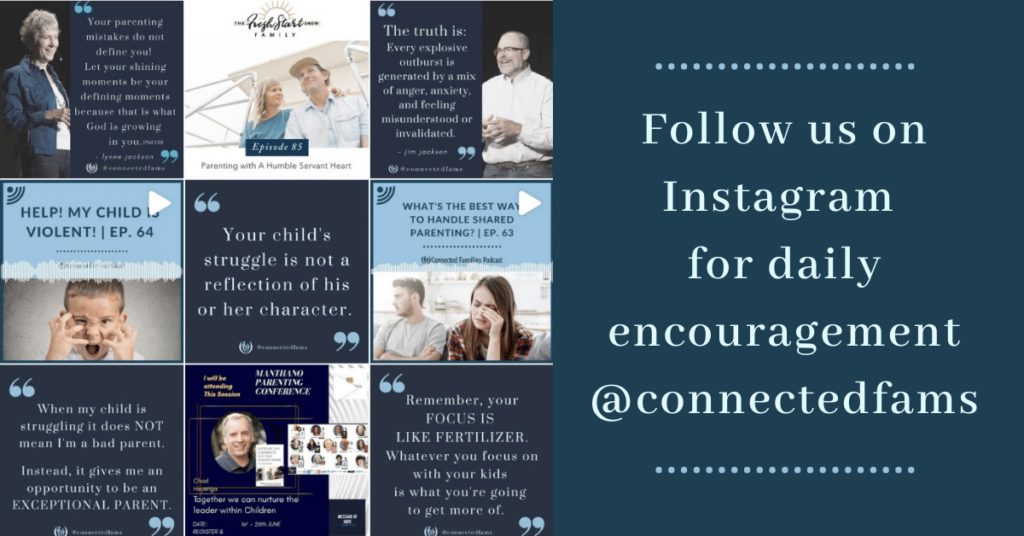
If you are not currently following us on Instagram, we encourage you to check it out. Our community is growing there, and we’d love to partner with you in your parenting with timely encouragement. Find us @connectedfams for your daily dose of parenting tips.