


Trash, Truth, Treasure: How to React When Someone Says Hurtful Things
The concept of "Trash, Truth, Treasure"

Summary: When learning how to react when someone says hurtful things, Connected Families’ “Trash, Truth, Treasure” tool helps you discard lies, acknowledge valid feedback, and hold onto God’s love. This biblical approach enables families to respond to painful words with grace rather than defensiveness, maintaining emotional safety while processing difficult conversations.
As adults it’s sometimes hard to know how to react when someone says hurtful things to you. But how do you respond when your child is the one receiving really mean, really hurtful comments?
When your child hears and experiences another child’s (or grown-up’s) hurtful words, it’s painful for you. Sometimes those words come from a sibling, and sometimes they come from a child they just met five minutes ago.
As you see your child escalating into distress, it’s natural to step in and try to fix it by saying things like, “Oh sweetheart, that’s not true.” Or, “You don’t deserve that.” Or you might even criticize the aggressor.
You’re not your child’s emotional manager
Quick-fix responses to hurtful comments may settle feelings down in the short term, but they’ll keep you in the role of managing all the complex emotions. Doing this repeatedly leaves your child ill-equipped to handle hurtful words without your help.
Kids, meanwhile, are often encouraged by friends and movies to come up with the smartest, sassiest, and funniest comebacks to rude comments. The problem is, if successful, they go from being hurt to hurting others. Instead, you can empower your kids to be thoughtful and resilient about mean words and hurtful comments, without hurting others back. After all, they will experience tough stuff in this broken world.
The problem with categorizing hurtful comments as good or bad
This takes some teaching. Especially under stress, the brain wants to quickly and efficiently drop our experiences into “good or bad” or “all or nothing” categories.
According to Psychology Today, “The term cognitive miser… describes how humans seek the simplest and least effortful ways of thinking. Nuance and complexity is expensive—it takes up precious time and energy—so wherever possible, we try to cut corners.”
But the problem is, all-or-nothing thinking is not very helpful and tends to lead to big emotional reactions or poor choices. Research reveals that all-or-nothing thinking is also more common in those with anxiety, depression, and self-destructive thoughts.
The good news is, when people say hurtful things or life overwhelms your kids, you have a great opportunity to prepare them to be overcomers. This begins with accurate and biblically grounded perspectives.
A smart response to rude comments: Trash, Truth, Treasure
In this article you’ll learn a simple tool for teaching your kids (and yourself) to stand firm in God’s love and truth when things get tough. Whether the stress comes from what others have said to them, what they are thinking about themselves, or about a situation they are facing, you can help them learn to navigate hurtful comments and thoughts.
We call this teaching ‘Trash, Truth, Treasure.’ The idea is, you can help your kids separate these experiences and thoughts into three helpful categories: hurtful trash, helpful truth, and heart-filling treasure.
This process could almost be considered an informal, biblically-based example of cognitive behavioral therapy for kids. But even more, it is discipling them toward maturity as they learn to “speak the truth in love,” starting with themselves.
…speaking the truth in love, we will grow to become in every respect the mature body of him who is the head, that is, Christ.
Ephesians 4:15
Helping kids think wisely about what others say to them is a good starting place for growing this maturity, because it’s obvious and concrete. Then, over time, you can build on that wisdom to address the more nuanced challenges of what a child is believing about themselves or a situation they’re facing.
So the next time one of your kids receives harsh words from someone, instead of trying to negate the statements, you can respond with, “That was kind of a hard thing to hear, wasn’t it?” Or if your child is quite upset, “Oh, you’re having some big feelings about that right now.”
Give your child a little time to experience their feelings. This is very important, so your kids see it as a helpful tool, not a way to shut down their emotions. Then you might say, “When you’re ready, I can help the wisdom part of your brain think through this hurtful situation.”

When they are ready, you can guide them out of fight-or-flight, black-and-white thinking toward a wise, helpful perspective. Explain each concept of Trash-Truth-Treasure to your child and then choose a question that would fit the situation.
Hurtful Trash: Unkind, untrue statements that can hurt us if we give them power
When we are hurt by others’ words, there are almost always elements of those words that are unkind and untrue. These are often spoken from someone’s frustration or discouragement, but sometimes out of a clear intention to hurt. Either way, if something is unkind and untrue, it has no value. Simply stated, it’s “trash” and should be discarded and disregarded!
To make this concrete for your child, you can ask what was said and then ask, “Was that kind? Was that true?” To make this a memorable exercise, your child can write down the hurtful words on a piece of paper (if they are old enough) and then throw the paper in the garbage can.
How Kerri, a coaching client, helped her son respond to his brother’s hurtful comments
Kerri shared:
Our boys were at each other with a lot of name-calling. Our more intense son even screamed at the top of his lungs, “I wish you were dead!”
But… we have two boxes— one for truth, one for treasure—so when it was all done, I separated the boys, and wrote down some of the most hurtful words. I asked his brother, “Is any of that something you want to treasure?” “No.” “Was any of it truth?” It was like a light came on, and he really understood that his brother’s words weren’t truth. So he tore that paper up because it was trash. That was powerful for him.
These brothers love it when Kerri, or her husband, Karl, take the “trash” statements from their conflicts outside and burn them!
The long-term benefits of this approach have been that we only need to say “Is that truth?” Or “That sounds like trash,” and they understand and often, not always, can let it go. I try to follow with what the truth is. We are still a work in progress, but it has helped a lot.
You can explain to your child, “When you throw these words in the trash, you are saying you don’t want unkind, untrue words stuck in your heart. That way you won’t carry untrue hurts around in your heart or accidentally pass those hurts on to someone else.”
How rejecting untrue, hurtful words permeated one family’s culture
Nine-year-old Blake would often come home from school in a fit of anger, venting his frustration at anyone in his path, usually due to interactions with his critical and shaming teacher. His mom, a coaching client, was helping him and his 6-year-old brother learn to separate what others said into “Trash,” “Truth,” and “Treasure.” One day Blake came home particularly upset and spewed angry, hurtful words at his mom as he came through the door.
His little brother compassionately responded, “Mommy, you just throw those words right in the trash!”
Over time, Blake did learn to talk about and understand his hurt and give less power to negative words from his teacher.
Proverbs 26:2 is a great verse to strengthen the confidence of any child upset by the harsh words of others: “Like a fluttering sparrow or a darting swallow, an undeserved curse does not come to rest.” One girl was so encouraged by this verse that she memorized it, and it strengthened her confidence so much that she neither fought back nor broke down in tears to her brothers’ taunts. She even had a mental image of shooing the “curse” off her shoulder.
Like a fluttering sparrow or a darting swallow, an undeserved curse does not come to rest.
Proverbs 26:2
Helpful questions to “Reject the Trash”:
- What did this person say or do that was unkind?
- What was untrue?
- What do you want to do to protect your heart from those things?
FREE DOWNLOADABLE PDF
Helpful Truth: Kind, fully true, and objective perspectives that can help us grow
Sometimes the things people say are true, even though you don’t like to hear them and you might feel hurt.
Proverbs 27:6a tells us, “Wounds from a friend can be trusted…” Think of a time when you learned and grew from someone’s accurate criticism, even though it was hard to hear. Your kids will miss important growth opportunities if they automatically lash back or blow off all criticism.
When hurtful words are part-Trash and part-Truth
Sometimes trash and truth are mixed together. This might happen if there is helpful truth in something that was overstated or said harshly. Consider if someone says this to your child, “You’re such a baby! You always have a fit when you lose.” Then he fires back with something like, “I am NOT a baby. You’re a baby!”
Here’s how you can help your child separate out the Trash from the Truth through thoughtful questions that build confidence and wisdom:
You: “Hmm. Those were some strong words. Let’s think about this. Are you a baby?”
Child: “No! I’m five!”
You: “That’s right. And is Ian a baby?”
Child: “No…He’s seven.”
You: “You know the truth! That’s so helpful! And do you always have a fit when you lose?”
Child: “No, not always.”
After you help your child toss away the “trash,” you can help them discover the truth of what was said:
You: “So you can put most of those words in the trash, right? But is it true that you do sometimes get really upset and yell when you lose?”
Child: “Yeah, I guess so…”
You: “That was really honest! If you want, I can help you learn to be more peaceful when you lose a game, so you’ll have more fun when you play.”
Whoever heeds life-giving correction will be at home among the wise.
Proverbs 15:31
For both kids and adults, learning to separate trash from truth is a life-changing skill. This guides you to see hard, yet helpful truths as a gift to help you grow towards God’s purposes. The best way to teach this will be your example, so tell your kids about it any time you learn and grow from criticism.
Helpful truths can also include insights that give perspective on the situation, such as knowing that hurtful words came from a child who has a particularly rough home life or a sibling who is deeply discouraged. Understanding the situation can ease the sting from something unkind and untrue. It can also grow compassion and a belief in your child that, “This wasn’t about me, it was about something going on in my friend/sibling’s heart because they are (hurt, anxious, discouraged, etc.).”

Helpful questions to “Respond to the Truth”:
- Why do you think this person might have been unkind? How could we pray for them?
- Is there a true thing that you could learn from this situation?
- What help do you need in this situation, and how could you get it?
Heart-Filling Treasure: Truths that encourage us and restore our joy
Life will throw hurts at us. We all need to know that God’s love is real, present, and powerful when we are discouraged!
The Lord is close to the brokenhearted and saves those who are crushed in spirit.
Psalm 34:18
“Heart-Filling Treasure” words are truths that encourage you and grow your confidence in:
- God’s love for you and your infinite value to Him. “The LORD your God is in your midst, a mighty one who will save; he will rejoice over you with gladness; he will quiet you by his love; he will exult over you with loud singing.” Zephaniah 3:17
- God’s purposes for how He made you. “I am fearfully and wonderfully made…” Psalm 139:14a
- God’s strength and help in times of need. “God is our refuge and strength, an ever-present help in trouble.” Psalm 46:1b
What does this look like in real life?
One of our readers told us how she helps her 8-year-old daughter focus on Heart-Filling Truth when her siblings taunt her. She starts by sharing this verse with her:
“Finally, brothers and sisters, whatever is true, whatever is noble, whatever is right, whatever is pure, whatever is lovely, whatever is admirable—if anything is excellent or praiseworthy—think about such things.” Philippians 4:8
Then she guides her daughter to hang on to “the Treasure” about herself:
“‘Desiree, what is true? Let’s think about these things.’ And then, ‘What does God say about you?’ Sometimes, if my daughter gets stuck, I help her with some phrases she can repeat: ‘I am beautiful, I am one of a kind, and God adores me!’ I always ask her if she believes these words, and sometimes through tears, she will nod her head yes.”
This little girl is learning to hang on to the truth about herself when things are hard. This is such a vital aspect of resilience, but even more importantly, of understanding God’s wonderful grace in practical ways.
“Heart-Filling Treasure” certainly doesn’t have to be a Bible verse. It can also simply be practical things:
- wonderful qualities or strengths your child knows are true about them
- ways they are growing and learning
- the many people who love them
- ways they are often a blessing to others
Finally, brothers and sisters, whatever is true, whatever is noble, whatever is right, whatever is pure, whatever is lovely, whatever is admirable—if anything is excellent or praiseworthy—think about such things.
Philippians 4:8
What heart-filling thoughts will restore your joy?
Treasure is something you can rejoice in! If you take the word rejoice apart and look at the etymology, it can mean a variety of things, including:
Re- = restoration to a former state
-joice = inward joy, gladness
So you can think of rejoicing as restoring a sense of inward joy!
When you or your child are struggling with hurt or discouragement, what heart-filling thoughts will restore your joy?
To make this concept of “Heart-Filling Treasure” concrete and memorable, you can work with your child to write treasure statements on slips of paper and put them in a special keepsake box, or write in a journal, or on a poster.
Be sure to work on your own collection at the same time and model standing firm on the truth of what God says about you when you are discouraged or hurt by someone.

Helpful questions to “Rejoice in the Treasure”:
- What do you love about how God made you?
- What true thought encourages you right now?
- What are you grateful for in this situation?
- What might Jesus (or someone who loves you very much) say to you now?
Want to learn more?
Check out Episode 97 of our podcast, “Teaching Your Child to Navigate ‘Mean’ Kids”
Lisa’s object lesson to teach “Trash, Truth, Treasure”
Lisa, a coaching client, used three-dimensional objects in their home to explain Trash, Truth, and Treasure:
“I talked with my girls about where we put things depending on what they are:
- a trash can (worthless things)
- compost (a source of growth)
- recycling (something valuable to be saved and used)
We looked at the containers for all three and talked about how words can fit into these categories. They liked this object lesson and talked about what words would fit into which place. It was really good for my daughter, who struggles with her sister’s harsh words and gives them power over her!”
How do you respond to hurtful comments and criticism?
Share with your kids your journey in this area, and celebrate even small steps of growth for any of you. When kids learn this, they are learning something most adults struggle with! Continue to reinforce their confidence: “When people say hurtful things, you can figure out what’s really true and what to do! Then you can learn and grow instead of letting your hurt or anger control you.”
Teaching kids this concept will prepare them well to face various challenges, including sibling conflict, peer pressure, and the impact of social media. You may even find them being more thoughtful about the words they use when speaking to others.
What about when the unhelpful and hurtful words are self-inflicted?
We’ve talked about helping kids with hurt feelings from other people’s words. What about when your child is believing some self-inflicted trash? Negative thinking can do as much damage as another child’s unkind words. If you are careful to validate your child’s emotions first and foremost, then you can sometimes use this format to thoughtfully help your child with hurtful, unhelpful thinking. This is especially true with thoughts rooted in anger or anxiety.
Help your child identify the Trash, Truth, and Treasure in their anger
Another coaching client, Laurel, shared:
“My 6-year-old daughter Emmie was outraged and crying over her little brother, Daniel, getting to go to work with Dad. We validated her disappointment first: ‘You really love one-on-one time with Daddy, don’t you? You probably don’t remember, but when you were three, you had days like this one, and you got to go to his work.’ We then helped her realize that she was believing that we only spend special one-on-one time with Daniel.
- Trash: The lie that you don’t get special time with us.
- Truth: You do! On Friday, it was just you and Mom when Daniel went to school, and we had a whole special day.
- Treasure: You are a dearly loved child of God! And even though you are doing so many amazing things at school, we love weekends so much because we get extra time with you! Let’s plan something special just one-on-one this weekend.”
A few minutes later, when Daniel got the last of the kid-favorite vitamins, the tears came even stronger, so we started again…
- Trash: I need to have the perfect vitamin!
- Truth: There is another one that is still yummy and healthy for me! We will buy more kid vitamins for tomorrow.
- Treasure: All my needs are supplied in Christ Jesus. We are so grateful that God has given us plenty of nutritious food to eat and enough money to buy vitamins to help us be healthy! (She really takes this to heart and is very compassionate for those who can’t afford these blessings.)
She then requested her favorite silly finger puppets, ‘Flopsy and Mopsy,’ to help her take her vitamins. It was a really helpful morning of playful instruction and connection.
Emmie actually loves ‘competing’ with Satan, the one who lies to her. We imagine him as a spider that dresses up in costumes trying to make her believe him, but actually, he is just a big, hairy spider who wants to steal her joy. He lies, and he wants you to be sad! We ask, ‘Are you gonna let him win? What is bigger: the hairy spider or God’s grace working in your heart?’
We played a game where I made a spider with my hands and said, ‘Keep crying, Emmie! Whine! Complain! Be sad!’ And she would laugh at it, and the ‘spider’ would run away and hide, tortured by her laughter.“
When kids are frustrated and upset, you can help them be angry directly at Satan the liar, or you can help kids just be mad at the lie. “Do you think it’s true that you always mess up?” “No!” “That means it’s a lie. Do you want to let that lie make you miserable again?” “No, I’m not going to let that lie make me miserable again.” “Let’s write it down, rip it up, and put it in the trash!”
Help your child identify the Trash, Truth, and Treasure in the middle of anxious thoughts
These three categories can also help kids struggling with anxiety. Sally shared how she helped her 9-year-old daughter at bedtime:
“Abby is very sensitive and easily scared. At bedtime, she can quickly think of anything and everything that has or could scare her. We’ve worked on it in several ways, but one night when I was tucking her in, I shared the idea of using ‘Trash, Truth, and Treasure’ to consider the thoughts she has before bed. So we talked through her fear and identified what was not true…
- Trash: I can’t fall asleep because I’m too scared! We talked about how that’s not true, and she could just throw that away. She emphasized, ‘Out to the stinky garbage can in the garage!’
- Truth: It’s true that sometimes we’ll get scared, and that’s ok! But it’s also true that God promised that He will NEVER leave us, ever! I told her that God is never distracted, too busy, or sending a text (real-life confession—there may have been times I’m distracted by my phone…), and God is always giving her His full attention. She asked, ‘How does He pay attention to everyone in the world?!’ We marveled together at how amazing God is.
And then I asked her what is a treasure she could think about while she’s falling asleep. - Treasure: God is with me and can help me feel safe and think about good and lovely things.
It seemed to really resonate with her, and it was helpful for me to have a specific way to slow down, put myself in her shoes, and think it through with her (instead of being frustrated by the same fears that usually prolong bedtime). Over time, her fears have diminished, and she no longer needs this. This process showed me how helpful it will be for me to think through these things when I’m afraid too!”
FREE “Bedtime Struggles” Ebook
Check out our FREE ebook, “Transform Bedtime Struggles into Nighttime Snuggles“
It’s holy work when you help your kids stand firm in God’s grace and truth. It prepares them to be overcomers when faced with harsh words or their own anger and anxiety. Here is a PDF you can print to help you integrate this into your family life.
“Finally, be strong in the Lord and in his mighty power. Put on the full armor of God, so that you can take your stand against the devil’s schemes…. Stand firm then, with the belt of truth buckled around your waist…”
Ephesians 6:10,11,14
Break the pattern of negative thinking and hurtful comments
It starts with you. Model identifying the Trash, Truth, and Treasure in the critical or hurtful comments you receive and in the thoughts you let yourself believe. Negative, untrue thoughts and beliefs have to be carefully identified and called out so we don’t give them power. Most adults still struggle to do this. This is good news! Because your child can watch you grow and learn, too.

You can show your child what it looks like to struggle and grow through the process of identifying and replacing hurtful words, critical comments, and negative thinking with helpful, healing thoughts. As you do this, you are building a more graceful and truthful family culture. Your kids will grow up knowing how to let go of the lies that are so easy to believe about themselves and others and how to replace them with God’s wonderful, grace-filled truth!
© 2022, 2025 Connected Families
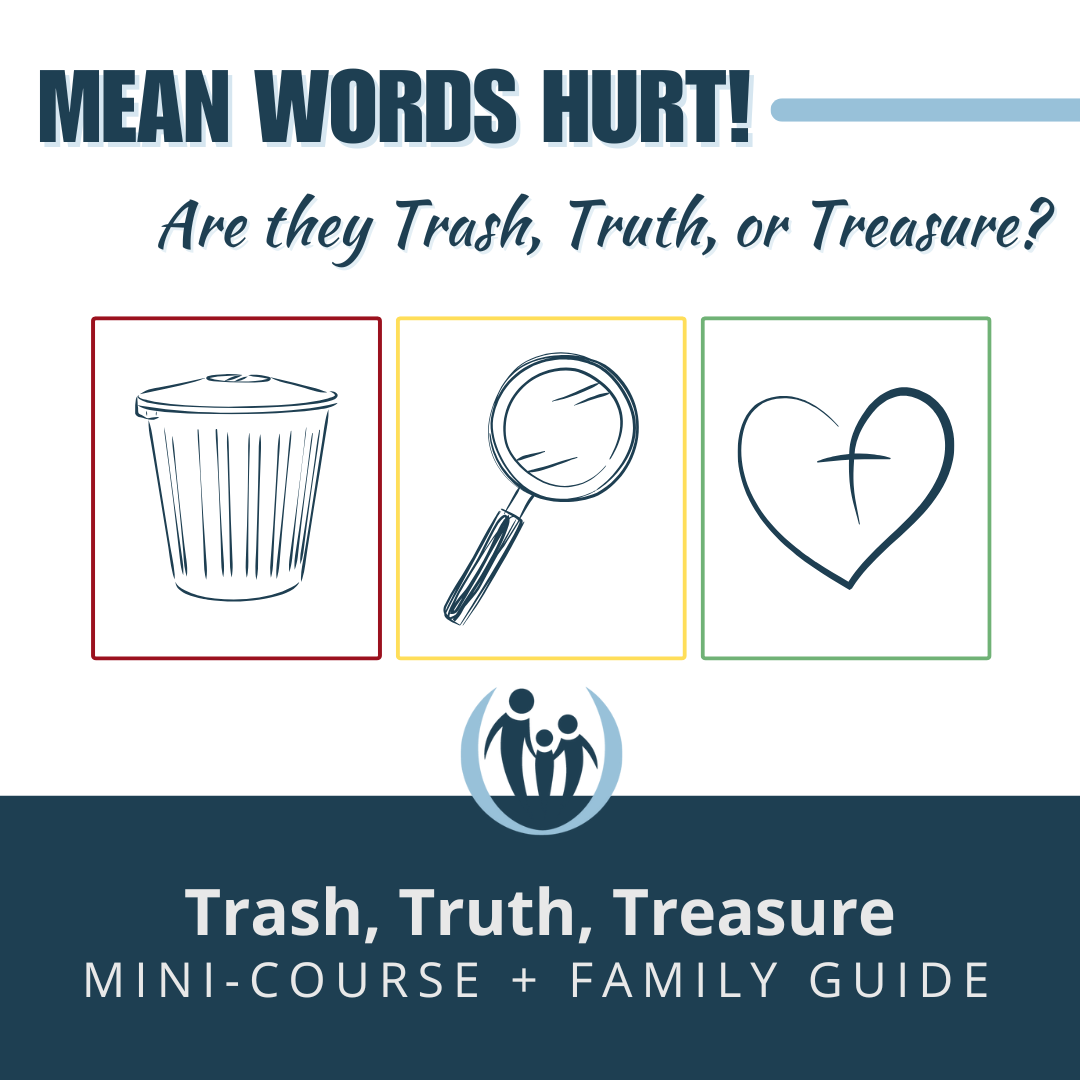
Does your child come to you with hurt feelings after someone says something unkind? Or maybe you hear their angry reaction first? You want to help, but you’re not sure what’s truly helpful.
This mini-course gives you practical tools to turn these everyday moments into powerful opportunities for spiritual and relational growth. You’ll be equipped with important skills to help your child stand strong against lies, grow from truth (even when it’s hard to hear), and anchor themselves in God’s love when things get hard.